Mesoamerican Network on Gender in Sustainable Energy (GENES)
April – July 2002
Prepared for the Energy Sector Management Assistance Program (ESMAP) of the World Bank
Prepared by: Winrock International
September 2002

ACKNOWLEDGEMENTS
This report reflects a joint and sustained effort among the various organizations and individuals who comprise and support the Mesoamerican Gender in Sustainable Energy (GENES) network, in particular its national and regional coordinators, and the energy and gender experts who were selected from the region to work together in linking gender methodologies with sustainable energy project approaches.
Asociación Andar, Adesol Honduras and Fundación CORDES deserve special recognition for their enthusiastic efforts in hosting the three workshops in Costa Rica, Honduras and El Salvador, respectively. Fundación NATURA from Panama, the National Technological University of Nicaragua, and Línea Biosfera from Chiapas, Mexico, also merit special thanks for leading the coordination of their countries’ participation in the workshops. Fundación Solar, as GENES regional coordinator, played a critical role in facilitating the execution of the workshop series, coordinating with all mentioned organizations and the three facilitators to ensure successful outcomes of the workshops. The authors would like to thank Fundación NATURA for the added financial support to the Costa Rica-Panama workshop, and to Vivian Lanuza, GENES Regional Coordinator, and her colleagues at Fundación Solar for ongoing personal and institutional commitment, both philosophical and financial, to advancing gender in energy throughout the region.
A special acknowledgement is due to the workshops’ facilitators, Aracely Hernández from Nicaragua, and Diacuy Mesquita and Suyapa Fajardo from Honduras, for whom the linkage of gender with energy was a new concept. The teamwork that emerged among the facilitators and coordinators was remarkable, and sparked a lasting awareness of the importance of gender to energy and vice-versa.
Finally, these workshops and the advancement of gender in energy in the region would not have been possible without the financial support of the primary sponsor, the World Bank’s Energy Sector Management Assistance Program (ESMAP), as well as the continued complementary support for GENES activities from the U.S. Agency for International Development (USAID). Both institutions seek to improve the ability of energy services to reduce poverty and provide means for equitable development through increased access by women and men to critical energy inputs. Their commitment to building regional capacity to enable this goal to be achieved is greatly appreciated by the GENES network and its supporters.
CONTENTS
| ACRONYMS |
| I. EXECUTIVE SUMMARY |
| II. BACKGROUND |
| III. WORKSHOP METHODOLOGY/CONCEPTS |
| IV. WORKSHOP RESULTS |
| V. CONCLUSIONS |
| VI. RECOMMENDATIONS |
MJMNF PREEICA PROLEÑA PROCCAPA
PROMUJER
PROGENIAL SAE SEDESOL Estatal SEDESOL Federal SERNA SOLARIS SOLUZ UNAN/ESECA RUCFA
UNI UTP WI
(Guatemala) Ministry of Youth, Women, Childhood and Family (Panama) Regional Electricity Project of the Central American Isthmus NGO with dendroenergy focus (Nicaragua) Conservation of the Panama Canal Hydrographic Watershed
Project Program for Promotion of Rural Women, Secretariat of Public Works of the First Lady (SOSEP) Program on Gender in Latin America, World Bank
Secretariat of Strategic Analysis (Guatemala) State Secretariat of Social Development (Mexico) Federal Secretariat of Social Development (Mexico) Secretary of Natural Resources and Environment (Honduras) Solar Systems of Honduras Soluz Honduras National Autonomous University of Nicaragua, Recinto
Universitario Carlos Fonseca Amador National Engineering University (Nicaragua) Panamanian Technological University Winrock International
Between April and July 2002, a series of two bi-national and one tri-national workshop on gender and sustainable energy was conducted for members of the Mesoamerican Network on Gender in Sustainable Energy (GENES). The workshops represent an important component of a project of the World Bank’s Energy Sector Management Assistance Program (ESMAP), managed by Winrock International in close collaboration with the GENES Regional Coordinator, Fundación Solar in Guatemala. Support from ESMAP is enabling the GENES network to undertake specific capacity-building and project development activities identified as priorities by the network, with receives complementary support from the U.S. Agency for International Development (USAID). Over 60 people from NGOs, universities, producer groups, government agencies and the private sector participated in the workshops, which were held between neighboring countries: Costa Rica and Panama; Honduras and Nicaragua; and El Salvador, Guatemala and Mexico. This report provides a synthesis of the outcomes of these workshops, including some insights into how energy sector and development practitioners and policy-makers can begin to put into practice more equitable and needs-responsive development initiatives where energy of one form or another plays a critical role.
These workshops, held in Costa Rica, Honduras and El Salvador, respectively, were developed to respond to a priority need identified by GENES members for increased capacity in the region to better respond to women’s and men’s distinct needs for energy services, particularly in rural areas, and to provide more equitable access to energy services that promote development in harmony with the environment. Few examples exist in Mesoamerica of rural energy initiatives that have taken gender-specific needs into account. At the same time, the region is full of development practitioners well-versed in the theory and practice of participatory, gender-sensitive approaches to understanding community needs, involving men, women, youth and elderly in defining what is priority and what is not, and in determining the most appropriate solutions for addressing the most pressing needs. Many such development practitioners are not, however, focused on or familiar with “energy” as a need, or of sustainable energy options that could meet those needs.
Through these workshops, GENES members sought to build an understanding of how exactly gender affects energy needs; how renewable energy technologies might meet distinct needs; and how to apply tools and methods that yield more gender-sensitive, more sustainable rural energy initiatives. ESMAP is helping to advance these objectives, providing support for the gender and energy workshop series, regional exchanges, and pilot projects that will apply the learning and provide new experiences and lessons for incorporating gender in energy.
Participants expressed overall high satisfaction with the workshops, indicating that their expectations were largely met if not surpassed. On behalf of their organizations and institutions, participants identified concrete steps that they believed should and could be taken as initial steps toward more gender-sensitive sustainable energy project and program development. At the same time, participants identified synergies among groups with complementary experiences within the same country, as well as in neighboring countries, thereby stimulating several collaborations on specific project proposals, and the identification of further follow-up exchanges in areas of mutual interest. These synergies and collaborations have strengthened the national sub-networks as well as provided a clearer identity and greater cohesion for the network at the regional level.
Workshop coordinators expect that the resulting insights will benefit not only the participants and their respective institutions, but also the broader regional and global community that seeks guidance on how to apply gender in energy.
During the GENES-ESMAP project launch meeting held in Antigua, Guatemala, in August 2001, GENES country coordinators validated the goals, objectives, and the central activities outlined for the funding being provided by the ESMAP program to the GENES network. The goals, objectives and activities were developed based on the vision and mission of the network, and priorities that had been voiced in previous coordinator meetings. These priorities were agreed upon by the World Bank Task Manager and the GENES-ESMAP project manager, Winrock International.
The overarching goal of the GENES-ESMAP project is to increase equitable access to sustainable energy by rural and peri-urban populations, so that available energy sources serve both women’s and men’s energy needs in the productive as well as domestic spheres. Specifically, the project aims to:
Identify, pilot and disseminate innovative energy techniques/systems that meet women’s and men’s multi-needs and uses, and at the same time are efficient, economically and technically viable, culturally and environmentally appropriate and sustainable;
Identify, adapt and test participatory approaches with a gender perspective, i.e. that work with and involve both women and men on energy techniques/systems for multi-needs and uses; Reduce time use due to energy-related tasks such as fuelwood and water collection, and ensure gender-equitable access to energy for productive and income generating activities; Identify constraints for introducing and operating new energy systems to meet women’s and men’s multi-needs and uses as well as opportunities for overcoming these constraints; and Disseminate findings within and outside the GENES network, the World Bank and other international organizations.
Within this framework, GENES national coordinators agreed to organize a series of encounters and exchanges among member countries to enrich understanding and capabilities related to gender and energy. The coordinators decided that a series of workshops, repeated around the region for GENES member organizations, was a priority for establishing a base of common understanding within the network and a basis for taking action to apply gender and energy concepts. Costa Rica, Honduras and El Salvador were selected as the host countries for three bi- and tri-national workshops, respectively.
While the workshops would be repeated with the same instructors and the same core objectives and agenda, coordinators agreed that it was important to include sessions on experiences specific to the participating countries, and to enable enough flexibility to respond to particular needs identified by participants. Reflecting GENES membership, some participants had experience with solar energy, micro-hydro, improved wood stoves or biogas, but little familiarity with gender concepts; others were familiar with gender-sensitive, participatory development processes, but had little information about experiences in the region with renewable energy technologies. Similarly, participants spanned a range of levels of influence, from government program planners to non-governmental development practitioners, university professors and researchers, and private sector entrepreneurs.
Two workshop facilitators from the region, one gender expert1 and one renewable energy expert, were selected through an open solicitation to conduct the series of three workshops. In this way, GENES coordinators aimed to establish consistency among the workshops; use resources efficiently; build relationships with local experts; and build capacity in each of the facilitators to address the other’s area of expertise.
1 Due to scheduling conflicts, the third workshop needed to be rescheduled to a time when the original gender facilitator was not available. Materials and concepts were transferred to the replacement facilitator to ensure the greatest consistency possible for the third workshop.
WORKSHOP METHODOLOGY AND CONTENT
Through a participatory process, GENES coordinators developed the following workshop objectives:
General Objectives
Motivate the incorporation of a gender focus and the use of renewable and/or sustainable technologies within the institutions, projects and programs of GENES member organizations, as well as other actors that seek to incorporate or otherwise associate with the network.
Present different renewable and sustainable energy technological options and their applications in
the region. Introduce the concepts of gender theory and their relationship with energy. Examine the intersection that exists between gender and energy. Initiate a process of increased involvement of women as beneficiaries and decision-makers in the
energy field. Establish a base of information, goals and initial commitments, as well as next steps. Identify opportunities for implementing projects in the short term that can demonstrate the benefit
of applying a gender perspective to rural energy initiatives.
Specific Objectives
♦ Become familiar with various types of renewable energy technologies, their applications and
trends in their use. ♦ Understand the principle concepts of gender equity. ♦ Reflect on the relationship between gender equity, sustainable development, and renewable
energy, and identify how key concepts of gender equity can be applied in the workplace and in the field. ♦ Familiarize with recent advances in the gender and energy nexus. ♦ Become familiar with gender methodologies, their uses and limitations.
At the onset of the workshop, participants completed a survey2 designed to establish baseline information on the participating organizations, including whether or not they had previously participated in gender training or had experience with renewable energy, whether their institutions had gender-sensitive policies, and so on. (See Annex 3 for surveys applied) Facilitators conducted an exercise to solicit participant expectations, using cards that were posted throughout the workshop. A final survey was conducted at the conclusion of the workshop, in which participants recorded specific actions that they believed their institutions could and should undertake to incorporate gender in energy initiatives. (See Annex 7 for specific actions identified by institution)
Workshop coordinators aimed to combine theory with enough practical tools and exercises to enable participants to immediately begin to put the concepts into practice following the workshops. Due to a strong request by GENES members for capacity-building in the fundamental principles of gender theory, and to establish a common base of understanding, the trainers introduced basic gender concepts using a combination of presentations, exercises, videos and discussions in large and small groups. The trainers agreed that understanding of basic concepts and terminology is essential for effective communication on the subject.
Thus, early in the workshops, the trainers demystified the term “gender,” which is commonly misinterpreted to mean “women;” illustrated gender roles, how they are defined by society, and how they can change; raised awareness of gender divisions of labor and how women often play a “triple role”, as
2 Developed by Fundación Solar (GENES Regional Coordinator) and Winrock International (GENES-ESMAP Project Coordinator).
domestic but unpaid worker, income-earner outside the home, and community care-taker; and introduced key concepts used in gender analysis, such as practical versus strategic needs and interests, and access and control of resources and benefits. The facilitators showed two videos3 commonly used among gender trainers in Latin America to illustrate socially defined roles of men and women in the household and in the workforce, and how these roles can change with changes in access and control of resources and other influencing factors.
As the workshops progressed, facilitators introduced common gender analysis tools and checklists, most derived from the Harvard Framework, focusing on those that were simplest to apply while at the same time reinforcing important concepts for any development project to address. (See Annex 4 for gender analysis guidelines and check list) Participants worked in small groups to apply these tools, first to exercises taken from gender analysis workbooks, and ultimately to actual projects with which the participants themselves were familiar.
The sustainable energy presentations included an overview of solar electric and solar thermal technologies; small and large-scale wind systems; small-scale hydroelectric systems; and biomass energy from direct combustion as well as anaerobic digestion (biogas). The facilitator presented pertinent characteristics of each resource, including its physical behavior, how it is measured, its reliability and its sensitivity to site-specific conditions; as well as basic system components, operations and maintenance requirements, relative economics, and common applications.
The thermal applications presented included solar hot water heating, crop drying (e.g. fruit, herbs, wood) and water distillation; and efficient cooking technologies and techniques (low fuel use, low emissions, high heat transfer) including from direct combustion of wood or other biomass (dung, coffee husks or other crop residue) in efficient stoves, use of biogas digesters, and fireless cooking with hayboxes.4 Electric applications included water pumping; telecommunications; lighting; appliances for household use and use in schools, clinics or other community centers, and micro-enterprises; grain grinding and other food processing. Mechanical applications included grain grinding with mills driven by hydro or wind energy.
To ground the concepts presented even further, each workshop incorporated a technology demonstration and/or a field visit to a project site where participants could see one or more applications of sustainable energy technologies. The field visits provided valuable, “un-programmed” time for open discussion and exchange of experiences among the participants. In the case of Costa Rica, the workshop was accompanied by a 2-day exchange on solar coffee drying and solar cooking. The second and third workshops included hands-on demonstrations of solar (photovoltaic, PV) lighting and water pumping, and brief field visits to projects involving PV pumping and electrification; solar fruit and wood drying; and improved cook stoves. These visits and the surrounding discussions reinforced participant interest in conducting follow-up exchanges to pursue specific innovations in more depth.
Given the prevalent and serious problem of inefficient fuelwood use and associated respiratory illness and environmental degradation around the region, a third video was shown5, a visual synthesis of the first
3 “Ana,” a ½-hour simulation of rural life. “El Sueño Imposible?”, a 5-minute animated film. 4 Hayboxes are known by various names, but the principle involves an insulated container into which a pot of food, which has already been heated, is placed to finish cooking by retaining the heat already transferred to the pot. Beans, for example, typically require 1 to 3 hours of stovetop cooking, depending on whether they have been soaked prior to cooking, on their type and on their age. The majority of stovetop cooking time (and associated fuel use) can be avoided by bringing the beans to a boil, removing them from the heat, and placing them in an insulated box or “tea cozy” that prevents heat from escaping. This is the equivalent of simmering. Some adjustments in time may need to be made to account for altitude (effect of atmospheric pressure). 5 “Intercambio Mesoamericano sobre Técnicas Efficientes de Cocción y Estufas Mejoradas”, Antigua, Guatemala, August 2001. Produced by Winrock International and World Bank/ESMAP.
GENES regional exchange supported with ESMAP funds. This video shares experiences around the region in recent years with a range of improved cooking techniques and technologies. In the Costa Rica workshop, the GENES coordinator shared a video of a field project where gender methods have been applied in developing an “eco-ranch”, including the use of agroecology techniques are being implemented by women and men.
Throughout the workshops, the trainers interwove the gender concepts presented together with men’s and women’s relationships to energy resources and services. Presentations and demonstrations on sustainable energy technologies and applications were interspersed with the gender concepts, and participants were able to see how women and men tend to have distinct needs and interests for energy services, depending on their gender roles, particularly in rural areas where division of labor is most notable. For those who previously were uninformed about sustainable energy technologies, their awareness was raised as to how certain applications might address one or more practical or strategic needs characteristic of women and men.
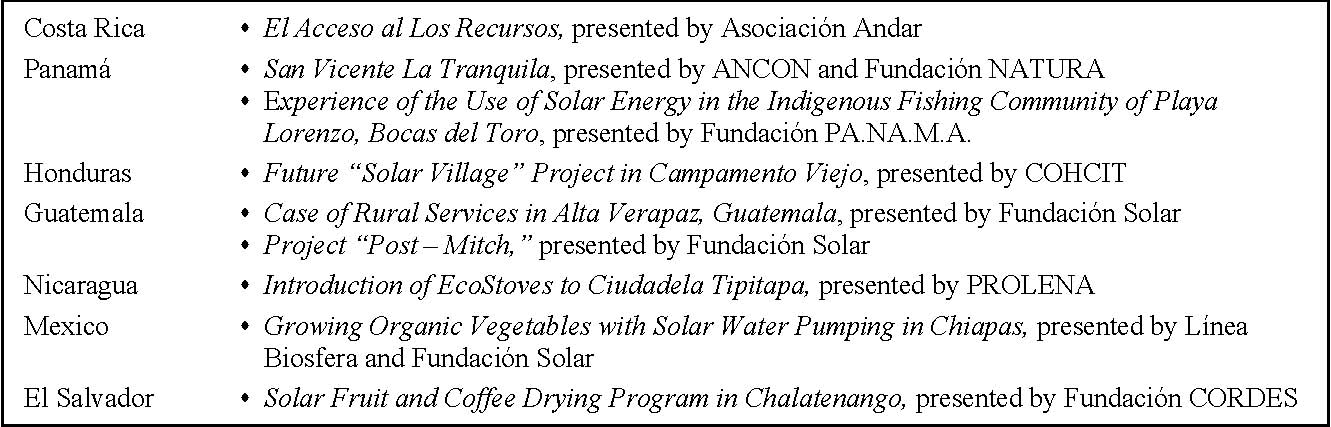
The learning process culminated in the application of gender analysis tools to “case studies” prepared in advance and presented by one or two groups per country. In preparation for the workshops, each national network had been encouraged to prepare a project profile or “case study” project for purposes of discussion and exchanging experiences. Group exercises focused on analyzing how the projects could be improved with a gender focus. Table 1 lists the case studies presented by each national network.
Table 1. Case Studies Presented
During the case study exercises, participants were asked to use the gender analysis tools they had learned in previous sessions to assess how well the cases presented had addressed gender within an energy project, if at all, and how these projects and ones similar to them could be improved by incorporating a gender focus. Participants developed access and control profiles, analyzed practical and strategic needs, and considered other relevant influencing factors. The facilitators asked participants to structure their discussions by addressing the following questions:
What key gender aspects were contemplated—or not contemplated—in the project? What were the impacts of having taken (or not) a gender focus? Which were the favorable and unfavorable conditions that were present, are present, and which
give potential for gender equity to be increased in this project? What recommendations can be offered in terms of concrete steps to:
- Improve the project presented; and
- Develop similar future projects that are gender-sensitive.
The preparation, presentation and group analysis of case studies by participants proved highly useful, both for purposes of having concrete examples with which to practice applying gender tools, and in terms of providing concrete recommendations to the presenting organizations on how their projects could be improved. The case studies underscored the relative absence of a gender focus in current renewable energy projects and the urgent necessity that this signals for a gender focus to be incorporated from the conceptualization stage of any project. The absence of a practical methodological guide for incorporating gender in energy interventions was also made very apparent. A summary of observations and recommendations resulting from the case study analyses is presented in the following section. For examples of the outputs of the group exercises, see Annex 5.
Also key to the workshops was the topic of gender-sensitive indicator development, as applied to energy innovations. A few participants had worked with developing gender-sensitive impact indicators for their projects; however, as expected, almost none of the energy practitioners have worked with indicators that aim to measure socio-economic impacts, and only one or two groups have tried to track even basic indicators on a gender-disaggregated basis. The workshops involved several discussions on indicators, including a presentation by Winrock on indicators developed to monitor the advancement of gender and energy in the region through GENES activities, including increases in local and regional capacity to incorporate gender in energy; changes in participation of men and women in project development and implementation; changes in institutional polices, practices and financial commitments to better meet women’s and men’s energy needs; and changes in the amount and reach of information exchange within and beyond the GENES network. (See Annex 6 for GENES-ESMAP project indicators)
In the Costa Rica and El Salvador workshops, respectively, two presentations on gender-sensitive indicators, one by a gender specialist6 addressing the stages of project conceptualization and development, and the other by an energy practitioner7 on initial indicators developed specifically for solar energy projects. Workshop participants agreed that more work is needed to develop a core set of indicators that can be relatively easily adapted to a variety of sustainable energy projects. The participants who have experience with gender-sensitive indicators development will serve as a valuable resource to groups that lack this experience, as they seek to monitor the impact of their projects. (See Annex 8 for a bibliography of relevant resources.)
6 Ileana Ramírez Quiróz, COOPESOLIDAR, Costa Rica 7 Leontine van den Hooven, Fundación Solar, Guatemala. Indicators developed by Katja Winkler and Leontine van den Hooven.
The workshops resulted in new understanding of concepts previously unfamiliar or poorly understood, including the term “gender” itself, which commonly gets misinterpreted throughout the region as referring to “women” or women’s issues, as unrelated to men or other family members. With this broader understanding of gender, and the exposure provided through case studies, technical demonstrations and site visits of practical applications of sustainable energy, workshop participants were able to identify specific actions that could and should be taken in each of their respective spheres of influence to ensure that both women’s and men’s needs are accounted for in energy projects and programs. Several collaborations were spawned to work together within a country to advance GENES objectives, and in some cases to work together on proposals for pilot projects to apply the concepts learned in the workshops and “learn by doing.”
During the workshops, participants worked in small groups to apply gender tools and techniques, such as those used to assess issues of access and control of resources and benefits, to case study exercises as well as to the cases presented by their colleagues of actual project experiences with rural energy. These exercises provided insights into new ways of approaching project development. Participants also worked in groups by country to identify synergies and actions that could be taken collaboratively within their national GENES networks.
The bi- and tri-national workshop structure appears to have been very useful for exchanging experiences and building regional bonds. The workshops brought together neighboring countries that share many common cultural, socio-economic and environmental characteristics, so that participants could identify to a large extent with the experiences of others. At the same time, participants from one country could benefit from the differences in perspective and approach of the neighboring country. Numerous ideas emerged about exchanges within and between countries that could further facilitate practical learning and lead to specific project action.
Outcomes presented here include:
Observations and recommendations made in case study exercises. Summaries of priority exchanges identified and pilot project proposals submitted by participants. Preliminary actions taken by participant organizations following workshops.
Case Studies: Observations and Recommendations
Examples of the case study exercises can be found in Annex 5. Specific observations and recommendations resulting from these exercises and ensuing discussions included:
Incorporate a gender focus from a project’s conceptualization through execution and follow-up.
Begin any project development process with participatory assessments with women and men to identify practical needs, and recognize the benefit of focusing projects on resolving those practical needs that tend to address strategic needs. For example, a project involving PV water pumping for crop irrigation, or a project on solar fruit drying, should not be aimed at growing and processing products for sale if they don’t first address basic nutrition needs (of children, elderly, women, men).
Recognize that energy is not an end in itself, but rather a means for achieving better life conditions. The renewable energy projects should respond to the demands of the community, for better acceptance. It is important that donor organizations support projects that respond to both practical needs as well as strategic needs, determined on a gender-disaggregated basis. This will significantly affect project sustainability.
Women should be included from the initial phase through the entire project, and should participate in the technical trainings. Technical field staff, producers, farmers, etc., should be made aware of renewable energy, with a gender focus.
Understand who has access and control of resources and benefits, to ensure that the projects will be fully adopted, and will be equitable. For example, in one case where women are in charge of irrigation for vegetable production and a savings fund created to provide small loans to women in the collective, if men have contributed the land (from inheritance), the labor for the well and the PV pumping, and are the ones to provide financial support through various sources of subsidy or credit (only provided to men, as landowners), then a tension may arise if the men then have no control over the project.
Inter-institutional coordination is key for developing this type of project due to the socioenvironmental context in which they exist. It is important to assess the positive and negative impacts of the projects to be implemented, to avoid resulting in a greater work burden for women (or men), rather than the intended impact of relieving time and physical burdens. Questions can be established to help value the projects, such as:
Who will benefit directly and indirectly from the energy project, and how?
What repercussions will the energy project have on daily life for men and women?
Who will be the responsible parties, or who will have control of and access to the benefits of the energy project? What activities will women and men engage in during the time that has been liberated by the energy project?
Indicators that enable project results—positive and negative—to be evaluated should be established from the very beginning. All projects should have follow-up and evaluation to measure the degree and permanence of the achievements reached. If it is determined that the project lacks a gender focus, it is important to make adjustments to enable the project to respond to the practical and strategic needs of the community.
In an example presented by the sustainable energy facilitator, a mini-hydro project that was implemented to promote productive uses in a community appears to be very “successful” when the “results” are tabulated. They include impressive numbers on the number of refrigerators, carpentry shops, small restaurants, dentist offices, bakery, electric grain mills, solder shops, pool hall, gas station, photocopy shop, radio station and rice processing business, all of which appear to bring benefits to the community. Specific benefits claimed include a large number of permanent jobs created, night classes in the school, lab services in the clinic, and water purification. Upon further assessment, however, the questions arise about who is benefiting from these services? Who owns the businesses? Who accesses and who controls the income? What is it used for? The answers to these questions are invisible, due to lack of disaggregated data (a minimum step), and more generally a lack of a more comprehensive gender focus. By establishing gender-sensitive indicators from the beginning, the impacts of this project would be much more thoroughly understood.
The level of organization of the community is very important for the sustainability of any renewable energy project, and it has been shown that women can play important roles within these organizations. Renewable energy projects should consider/take into account organizational and enterprise formation and strengthening assistance, as well as training for personal empowerment with equity.
A methodological guide should be developed by GENES to synthesize these and other lessons in the most practical and accessible format possible.
Action Items Identified by Country
On the last day of the workshop, participants were given time to work in groups by country to identify concrete actions that could be taken in the short, medium and long term, with the objective of determining which would be next steps to follow at which levels: by institution, as sub-networks at the national level, or at the regional network level. This visioning of actions represents an important input for GENES as a network, as well as for ESMAP, in order to best determine the best investment of resources and reduce inequities.
The following table synthesizes the concrete actions presented by the participants as a result of their discussions by country.
Table 2: Action Items By Country
| COUNTRY | ACTIONS BY COUNTRY |
| Costa Rica | • Replicate the workshop: energy, gender and sustainable development • Hold an exchange on lessons learned with improved stoves. • [note that group exercise yielded mostly good lists of “who’s who”, rather than specific actions] |
| Panama | GENES-Panama: • Establish a training center of clean technologies in the Canal Zone. • Establish a community in the Darién province as a model for the use of improved stoves and biodigester, as a complementary component to an existing project integrating agroecology and school kitchens for improved nutrition. • Take action to include of gender as a specific area of study within the post-grad and Masters programs offered by the faculty of Mechanical Engineering at the Technological University of Panama, with support from other participant organizations. • Take action to include sustainable energy as a complementary subject in the Donations program (gender already included). • Work on policy influence, raising awareness of the existence of “friendly technologies.” • Promote exchanges with organizations from Costa Rica, given the proximity and contacts established. • Develop joint initiatives among GENES-Panama network members within Panama, as well as at an international level with Costa Rica, with the aim of promoting development of marginalized groups and communities, particularly women, indigenous and youth. |
| Honduras | • Focus on a specific project to explore possible collaborations. Project should integrate gender concepts and sustainable energy technologies into an existing “multi-use ecological farm” in El Hábeas, Choluteca, with the aim to increase environmental consciousness, protect natural resources, and promote ecotourism and sustainable development in the surrounding communities. Project planning would involve the application of gender-sensitive socioeconomic studies and participatory methods. • The Honduran Council on Science and Technology (COHCIT) will focus on its fourth “Solar Village” (Aldea Solar) project which it plans to use as a model for future Solar Village projects, taking lessons from the preceding three projects, as well as insights from this workshop. Workshop participants generated useful insights for COHCIT, applying gender analysis questions and analyzing issues of access and control to resources and benefits in the project. • Seek experiences with improved stoves; Eco-stoves of particular interest. |
| Nicaragua | • Create an “annual plan” for GENES-Nicaragua, based on the needs identified by network members. • Develop proposals to seek financing for rural energy initiatives utilizing sustainable energy. • Begin applying tools acquired in workshop to develop more equitable projects, while seeking further assistance in the incorporation of gender in project formulation, implementation and evaluation. • Hold exchanges to increase experience with application of gender methods. |
| El Salvador | • Identify and visit experiences with solar water pumping for crop production. • Seek assistance in revising project design to include gender focus, to integrate rural participatory assessments with a gender focus from the beginning of project development. • Present to GENES a proposal on fruit dehydration and coffee drying, to initiate in 2002. • Host visitors and share experience in solar drying with women’s groups. • Seek assistance in creating a network for women and men users of solar energy systems. • Disseminate information on the experiences shared at the workshop with other GENES members. • Synergies identified (beyond participants) included a large number of community-based organizations and local NGOs, as well as the environment ministry (MARN), two universities, and the El Salvador Environmental Protection Program (PAES) managed by ABT Associates and implemented by |
| Winrock/El Salvador. Areas of expertise and experience among groups identified include: solar | |
| drying of fruit, coffee and wood (for furniture and crafts); water pumping with PV and with bicycle | |
| pedal power; and pedal-powered grain grinding. | |
| Mexico | • Visit projects involving solar dryers in Guarjila, Chalatenango, El Salvador. Invite decision makers as well as producers. |
| • Visit rural education centers in Honduras (September). | |
| • Visit women assemblers of solar PV panels and of efficient wood stoves (EcoStoves) in Nicaragua (October). | |
| • Hold meetings with municipal authorities, as well as other social and institutional actors. | |
| • Carry out additional gender and sustainable energy workshops. | |
| • Gather information and research on the use of renewable energy in Chiapas and/or Mexico in general. | |
| • Identify and catalyze gender and energy projects. | |
| • Promote new membership in GENES-Mexico. Synergies identified (beyond participants) included several state and federal institutions with funds and programs potentially relevant for gender and sustainable energy initiatives, including the Institute for Women, local and municipal authorities, the National Forest Commission, the Institute of Natural History and Ecology, and the Secretary of Agrarian Reform. Some of these institutions have gender policies that mainstream the topic across all programs; others promote renewable energy and may or may not have gender-sensitive policies. | |
| Guatemala | • Develop a map of actors, pursue synergies, and organize exchanges. |
| • Determine the success and projected future of improved stoves programs, including results of studies by the University of El Valle and University of California at Berkeley on exposure to indoor air pollutants for different stove interventions. | |
| • Establish inter-institutional initiative on solar drying, including exchange visits to relevant projects. Of particular interest to NGO Association Ak’ Tenamit in Izabal, which is already sensitized to gender issues. | |
| • Coordinate a meeting within the energy sector on policies and indicators with a gender focus, with key actors in the political, economic and social spheres. | |
| • Synergies identified beyond participants include: the National Rural Electric Cooperative Association (NRECA); the National Network toward Equity (REDNA/Fundación Guatemala); the Association of Gender Equity of the Electricity Subsector of the Central American Isthmus (ASEGICA); the Gender Unit at the Ministry of Agriculture, Livestock and Food (MAGA); the Women’s Consultative Group of the Ministry of Health; UNICEF; the Presidential Secretary for Women (SEPREM). |
In addition to these group outputs, each participant identified institution-specific actions on behalf of his/her organization or institution, in a final, brief survey administered prior to closure of the workshops. Workshop facilitators encouraged participants to be as concrete as possible in identifying practical next steps that could be taken, according to the institutions’ particular strengths and deficiencies, to approach more gender-sensitive, more sustainable development in which energy plays an important—if under-recognized—role. Participants were also asked to indicate the synergies they had identified with other participating organizations, or with those that were not able to attend the workshops. The results of this survey were tabulated, dividing the responses into the four basic categories into which they tended to fall: policy influence, capacity building, project development, and synergies (though some responses could qualify under more than one category). (See Annex 7 for the results of the surveys, by institution).
Exchanges and Pilot Projects
GENES members repeatedly have emphasized the value of learning from one another by visiting field experiences. The workshops themselves provided brief field visits, which further underscored participants’ interest in visiting other members’ projects. The following priority exchanges were identified during the workshops through group discussions and less formal interactions among participants.
Table 3: Exchanges Identified by Participants
| Exchange sought by: | Focus of Exchange | Exchange with: |
|---|---|---|
| Costa Rica | 1. Lessons learned with improved stoves | 1. Nicaragua (TBD) |
| Panama | 1. Improved stoves, solar ovens | 1. Nicaragua (Proleña, Grupo Fenix); Costa |
| FUNPRODA, Fundación | 2. Biogas digesters | Rica (Casa del Sol) |
| PA.NA.M.A., CEMP, UTP, FIS | 2. Costa Rica (Asoc. Montaña Verde) | |
| Honduras | 1. Improved cooking techniques, stoves | 1. Nicaragua (TBD) |
| Ayuda en Acción | 2. Solar drying | 2. El Salvador (CORDES) |
| Compartir | ||
| Adesol | ||
| Nicaragua | 1. Application of gender methodologies to | 1. Costa Rica (Asoc. ANDAR) |
| UTN, CNE, Proleña, UNI, | energy-related development projects | |
| ESECA/UNAN, SOCODEL, | ||
| CIAB/BICU | ||
| El Salvador | 1. Solar water pumping for micro | 1. Mexico (Línea Biosfera) |
| Fundación CORDES | irrigation with women’s producer group | 2. El Salvador (CORDES) |
| Winrock/El Salvador | (CORDES) | |
| 2. Solar fruit drying (WI/ES) | ||
| Guatemala | 1. Solar fruit and wood drying | 1. El Salvador (CORDES) |
| Ak’ Tenamit | ||
| Mexico | 1. Solar fruit and wood drying | 1. El Salvador (CORDES) |
| Línea Biosfera | 2. Rural education centers | 2. Honduras (COHCIT, Adesol) |
| Unión de Uniones ARIC | 3. PV module assembly and improved | 3. Nicaragua (Grupo Fenix, Proleña) |
| SEDESOL | stoves | |
| Key decision makers | ||
| Users |
As can be noted from the table, participants have placed an emphasis on learning more about improved cooking techniques and efficient stove technologies. Most participants consider the health, socioeconomic and environmental impacts of dependence on fuelwood and its use in inefficient open fires as representing an ongoing, significant problem that hinders development in rural and peri-urban environments. Exposure through the video on the Antigua regional exchange to the experiences shared with a new generation of cooking innovations, as well as first-hand accounts from workshop participants, reinforced interest in hands-on experience and evaluation of specific innovations for the particular conditions and circumstances for each group.
The experiences shared in discussions by ANDAR-Costa Rica and in situ by Fundación CORDES (El Salvador) in solar drying of medicinal plants, fruit and wood, also drew great attention. Participants saw value in solar drying from a variety of angles, including for its ability to facilitate food security by lengthening the shelf-life of fruits; complement agroforestry initiatives by reducing production waste of fruits too voluminous to be transported to market; and spur micro-enterprises in value-added product directed at local, regional and international markets.
While the majority of regional exchanges focused on one or more specific technological innovations of interest, participants seeking to build experience in the application of gender methods tended toward local partnerships and collaborations with groups experienced in this area. Asociación ANDAR (Costa Rica) is one of the few organizations that have been working over several years in both gender approaches and sustainable energy. Though small in size, ANDAR can offer useful insights from its experiences working with men and women in agriculture and solar energy in its various forms. Línea Biosfera (Mexico) has built a similar trajectory and base of experience in combining gender-sensitive participatory methods for identifying priority community needs and formulating integrated development plans, including solar energy for water pumping and micro-irrigation. Fundación Solar (Guatemala) has more recently been working to address gender issues internally, as well as developing an initial set of gender-sensitive indicators for PV and household energy projects. The experiences of these GENES coordinator organizations provide valuable examples for the region.
Other groups, such as the Panamanian Center for Women (CEMP), the Center for Family Training (CEFA), and the Ministry of Youth, Women, Children and Family of Panama, are examples of both governmental and non-governmental institutions that have worked with gender concepts, from gender-sensitive policy to indicator development, that serve as valuable resources and potential collaborators for organizations lacking this experience. Among the useful synergies in Panama and likely other Central American countries is with organizations and individuals who have participated in the World Bank Gender Unit’s PROGENIAL program, which has worked around the region to develop sensitivity to gender equity within Bank projects in the region, including developing gender-sensitive impact indicators and monitoring plans to reduce gender differences that favor development and benefit all of society. Participants who have worked with PROGENIAL have developed valuable skills and can share insights on indicator and policy development. At the same time, their already gender-sensitized projects may be able to benefit from new knowledge of sustainable energy technologies and applications.
Pilot Project Proposals
A few of the collaborations spawned are highlighted in the proposals submitted following the workshops, seeking ESMAP support of specific pilot projects. Proposals for pilot projects were solicited for ESMAP support, following each workshop, with the following evaluation criteria:8
- Be complementary to a project in process or approved for implementation in 2002-2003.
- Be innovative in the integration of gender with sustainable energy.
- Demonstrate the participation of women and men in the identification of their respective needs, and in the development and implementation of the project.
- Show the expected benefits and impacts, with emphasis on women where traditionally they have earned less or had less access to resources. Among impacts sought are the following:
- Reduction in indoor air pollution and improvement in the health of women, men and children;
- Reduction in the time dedicated to domestic chores, such as fuelwood collection or water retrieval;
- Increase in women’s and men’s access to energy services for productive uses and income generation for family benefit;
- Increase in participation of women and men in the decision-making processes related to the use and management of energy resources.
- Be designed with indicators addressing cultural, environmental, social, technical and economic sustainability, considering the following factors:
- - The efficiency of the technological innovation, as well as its technical, environmental and economic viability (e.g. contributions from the beneficiaries (women and men); micro-finance or credit mechanisms; operations and maintenance over the long term);
- - Community organization;
- - Social and cultural acceptance of the project;
- - Local resources and manufacturing of the technology involved, where possible.
- Have the greatest possible potential for replicability.
Panamanian participants formed two proposal teams, each submitting proposals for projects that would address health and environmental impacts of fuelwood cooking, while complementing existing programs
8 These proposals were submitted to the project selection committee by mid-August 2002. Final selection of the two proposals to receive ESMAP support is pending.
in conservation, in one case, and school kitchens and agroecology in the other. The proposal teams pair more technically focused institutions with those that have had experience in applying gender methods, including developing gender-sensitive impact indicators.
Similarly, Costa Rican groups are collaborating on a proposal for an integrated development approach in an indigenous community bordering on Panama. The group would combine existing efforts and experience in solar PV electricity service provision of the national utilities, with experience from the NGO Asociación ANDAR in gender-focused agroecology projects, which include solar drying of medicinal plants and organic fruits for local nutrition and micro-enterprise, and involve access to micro-credit.
In Nicaragua, academic groups are beginning to share experiences in renewable energy technologies, on the one hand, and gender theory, on the other, to begin to forge new approaches, experiences, research and curricula to build a new base of experience with the gender-energy nexus.
Proposals were also received from El Salvador and Guatemala. A summary of the proposals received is provided in Table 4.
Table 4: GENES/ESMAP Pilot Project Proposals9 2002-2003
| Project Title / Institution / Country | Proposed Project |
| Project to apply gender focus in the context of | Incorporate a gender component in an expanding and innovative project |
| energy applications for production of [dried] fruit | that das value to agroforestry production through solar fruit and coffee |
| and aromatic and medicinal plants, as well as dried | drying in 10 rural communities. |
| coffee. | |
| Institution: Fundación CORDES | |
| Country: El Salvador | |
| “Sustainable Energy Contributes to Nutrition and Environmental Protection” Institution: Fundación Pro Niños de Darién (FUNPRODA), with UTP, Fundación NATURA, CEMP, CEFA, Fundación PA.NA.M.A. Country: Panama | Technical assistance for the adoption of an appropriate improved stove and a biodigester in a rural school, under FUNPRODA’s nutrition and ecologically sound farming programs, with the objectives of decreasing the following negative impacts: Health (smoke); Fuelwood consumption and hauling for men and women; and Poor management of pig waste. |
| “Improved Stoves and Community Participation in the Community of El Cauchal” Institution: Fundación de Parques y Medio Ambiente (PA.NA.MA), with PROCCAPA, APRODECA Country: Panama | Identify and implement an appropriate improved stove model for 20 families in a rural, indigenous community, with the following characteristics: Efficient cooking; Conserve fuelwood; Appropriate height; and Decrease smoke. |
9
In addition to the full proposals, two concept ideas were also received from Nicaragua with potential for future GENES support:
A) “Fuel-saving Stoves Combined with Local Cookers,” presented by Asociación Fénix.
B) “Development of Coffee Husk Briquettes for Groups of Women in Rural Areas,” presented by Universidad Autónoma
de Nicaragua (UNAN).
18
| “Hydroelectric Power for Integrated Community | Strengthen small textile businesses through the introduction of a micro- |
| Development” | hydro system in 1998, and substitute domestic electricity for fuelwood |
| use in a rural community of 80 people, through rehabilitation and | |
| Institution: Biomass Users Network Central | optimization of the 15 kW system. |
| America (BUN-CA) | |
| Country: Costa Rica | |
| “Pilot Commercialization of Improved Stoves by | Incorporate a gender focus in a project to commercialize the “Eco |
| the NGO Proleña” | Fogón” (Eco-Stove) supported by ESMAP/World Bank. |
| Institution: PROLEÑA | |
| Country: Nicaragua | |
| “Capacity Building Courses for Women in Dos | Create a permanent culture of efficient energy use through the |
| Asentamientos, Managua, on the Rational Use and | development of capacity building courses for peri-urban women in the |
| Advantages of Energy” | efficient use of energy within the household. |
| Institution: Technological University of Nicaragua | |
| (UTN) | |
| Country: Nicaragua | |
| “Implementation of Renewable Energy in the | Obtain a photovoltaic (PV) demonstration system for educational |
| Educational Processes of Q’eqchí Girls in the Río | purposes, oriented principally toward indigenous girls in a rural |
| Dulce region of Izabal” | community. |
| Institution: AK’ TENAMIT | |
| Country: Guatemala |
Actions Taken to Date10
Between August 2001 and August 2002, support from ESMAP has enabled the workshop series as well as two exchanges, one regional11 and one bi-national.12 The impact of the numerous synergies catalyzed by the workshops can only be truly measured by the changes they affect over time. Follow-up has begun to detect progress on the specific actions identified by each participant on behalf of his or her institution, and by the country groups as national networks. Preliminary findings are encouraging; a synthesis is presented below. The outcomes reported here are preliminary and only partial, in that they represent a small portion of the GENES members and other groups who have participated in GENES-related activities in the last 12 months, including the workshop series and the two exchanges supported by ESMAP. These outcomes do, however, highlight the powerful impact of convening members from neighboring countries to share experiences with gender-sensitive methods on the one hand, and sustainable energy technologies on the other.
Some of the progress detected thus far will fit into the GENES-ESMAP indicators as they were outlined prior to the workshops; other steps taken may not fit well or otherwise register in quantifiable terms as yet. As evidence builds that actions are being taken in each country, previously identified indicators will
10 As of September 2002. Workshops conducted as follows: Costa Rica/Panama: April 29 – May 1, 2002 in San José, Costa Rica. Honduras/Nicaragua: May 28 – 30, 2002, near Valle de Angeles, Honduras. El Salvador/Guatemala/Mexico: July 9-12, in Arcatao, Chalatenango, El Salvador. 11 Mesoamerican Regional Exchange on Efficient Cooking Techniques and Improved Stoves, Antigua, Guatemala, August 2001. 12 Exchange for Panamanians in Costa Rica in conjunction with bi-national workshop, including visit with GEF project on solar drying of organic coffee and hands-on solar cooking at Casa del Sol. April 2002.
be revisited and discussed with country sub-networks to determine how best to measure progress, from their point of view.
COSTA RICA
National Power and Light Company (CNFL)
♦ Head of the Department on Energy Conservation (which includes renewables) is supportive of staff receiving training and promoting gender issues within CNFL and its projects, as a result of the participation of 2 staff in the bi-national workshop.
♦ Among the initiatives being considered since the workshop is the creation of a Gender office within the company. Currently the company does not comply with a law established in 1994, the Promotion of Women’s Social Equality Law, that states that all government-related agencies must have a Gender office.
♦ Following the workshop, one of the two CNFL participants gave a brief seminar to fellow staff on gender issues, representing the first company-sanctioned event focused on gender topics. Most (~80%) CNFL staff are male engineers.
♦ As a result of the workshop, CNFL has been working with the Costa Rican Electricity Institute (ICE, utility), the University of Central America (UCA) and the NGO Asociación ANDAR, to formulate a joint project proposal for a “model community” with the following components:
- PV household systems for indigenous community, provided as fee-for-service by ICE.
- ANDAR will provide capacity-building in solar drying of medicinal plants, along with assistance in gender-sensitive community organization and micro-enterprise development (including organic bananas);
- Technical assistance from UCA on the solar dryers; and
- Information dissemination and promotion by CNFL, as well as training support by CNFL staff in PV system operations and maintenance, for the women and men of the community.
Asociación ANDAR, GENES-Costa Rica Coordinator
♦ Asociación ANDAR has worked with CNFL, ICE and UCA to formulate a joint project proposal, per the description above, for an indigenous community where it has provided community development support.
♦ ANDAR has identified people from the water sector interested in GENES.
PANAMA
National GENES follow-up:
♦ All participants (representing 10 institutions) have met several times since the workshop, and have instituted monthly meetings.
♦ Six groups have prepared a joint proposal for an appropriate improved stove and biodigester to create a model school under a large program including an agroecological farm to provide a balanced and diverse diet for students and their families.
♦ Have independently formalized the national network, and developed a Work Plan for GENES-Panama (August 2002). Details of Work Plan pending further follow-up discussions.
Fundación Pro-Niños del Darién (FUNPRODA)
♦ The FUNPRODA participant in the Costa Rica-Panama workshop reports that the workshop has totally changed her perspective on the way FUNPRODA approaches project development. She sees how institutional assumptions about what is needed in a community and its families may lead to failed projects if a concerted effort is not made to understand the family members’ perceptions of their priority needs. FUNPRODA is thus now working on re-articulating their institutional policies and Strategic Plan to include specific gender-related indicators, including those that capture the needs and motives of different family members in order to guide project design.
♦ As an example of a changed approach related to improved stoves, improved stoves have previously been promoted by the Panama government’s Social Investment Fund (FIS) and others as a means to reduce deforestation in Darién’s protected areas. Women were not convinced of the importance, and in many cases have not adopted the stoves. In contrast, FUNPRODA has returned to communities to ask women, men, and children about the traditions, needs and impacts of cooking with open fires. As a result of discussing issues associated with fuelwood collection, smoke, sanitation, bent backs over the ground-level fires, and time requirements, all family members are expressing great interest in improved stoves.
♦ Three stove models were to be tested, compared and evaluated by women and men in the Darién, on September 5, including an Ecofogón (developed by Proleña), which was recently brought back from Nicaragua by Fundación PA.NA.M.A.
♦ The FIS planned to attend this stove testing event, with the objective of determining which model is most suited for school kitchens and families, as well as what modifications are necessary to make the stove most appropriate for manufacturing in the region.
NICARAGUA
National GENES follow-up: The network has decided to meet once a month. So far, all groups have arrived to the meetings held since the workshop in Honduras (May).
Nicaragua Technological University (UTN), GENES-Nicaragua Coordinator
♦ UTN professors from the Population and Environment Unit within the Environmental Engineering program held a brief seminar on gender and energy for undergraduates. ♦ The Bluefields Indians Coastal University (BICU) held a similar event on gender and energy for professors. ♦ UTN submitted a proposal for providing training to peri-urban women around Managua in efficient fuelwood use.
Proleña
♦ Seeking to integrate gender focus within project being co-implemented with the National Energy Commission (CNE) of 3000 Ecostoves. Details pending.
National Autonomous University of Nicaragua (UNAN)
♦ Participant planning a graduate course on gender and energy within the Agricultural Engineering program.
EL SALVADOR
Fundación CORDES, GENES-El Salvador Coordinator
♦ A link has been made between the GENES network and the World Bank’s Gender Unit, whose recently appointed focal point was closely involved in the workshop preparation.
♦ CORDES is eager to implement specific projects, incorporating a gender focus to ensure full participation and distribution of benefits among family members. CORDES reports that the workshop provided useful tools for improving the impact of its projects. Current project focus is expanding upon a pilot project supported by the Austrians on solar-dried fruit, managed by three women. CORDES has submitted a proposal for ESMAP support to replicate the solar fruit drying experience to 10 additional communities, while taking a gender focus to better utilize women’s and men’s skills and interests, and to increase opportunity for both women and men through commercialization of premium value fruit products.
GUATEMALA
Fundación Solar, GENES Regional Coordinador
♦ Fundación Solar prepared a case study for the workshops that was used as input for a paper on gender and energy presented at the World Summit on Sustainable Development (WSSD) in Johannesburg in August, 2002, with support from ENERGIA.
♦ Fundación Solar was invited by the Latin American Energy Organization (OLADE) to attend a regional conference in Quito, Ecuador in October 2002, on the Energy and Environment Legal Information System under the new phase of its Energy and Environment Program. Fundación Solar has been asked by OLADE to speak at this event on gender in Central American policies, in institutions, and in rural energy projects, highlighting the use of gender and energy methodologies and indicators. The University of Calgary and the Canadian International Development Agency (CIDA) are supporting this program.
♦ Fundación Solar has begun to exchange and disseminate information with the Association for Gender Equity in the Electricity Sub-sector of the Central American Isthmus (ASEGICA) and other organizations, such as the National Electrical Energy Commission (CNEE), Ministry of Energy and Mines (MEM) and the National Electrification Institute (INDE).
Ministry of Energy and Mines (MEM)
♦ The workshop underscored the learning that the Ministry has done in the relationship of gender to energy, through GENES and associated events in recent years. The Ministry is now planning the creation of a gender unit through which policies will be established both for the renewable energy unit as well as the Ministry as a whole. The Ministry has presented proposals to the Inter-American Institute of Agricultural Cooperation (IICA) and to the Central America Regional Electrification Project (PREEICA) through the recently established Association of the Electric Sub-sector and Gender in the Central American Isthmus (ASEGICA), to provide assistance in coordinating the creation of the gender unit.
Ministry of Health (MSP), Health and Environment Unit
♦ The workshop reportedly opened a new panorama for the participant, who sits on the Consultative Council for Women within the Ministry. The Ministry currently has a policy on gender equity, and is seeking to incorporate gender-sensitive practices in all its programs. The Health and Environment Unit is beginning to incorporate gender through a household energy program wherein the Ministry expects to assist with the measurement of health impacts of open fires and related technology interventions.
Ak’ Tenamit (NGO)
♦ Ak’ Tenamit, an NGO dedicated to promoting the self-determination of the Q’eqchi’ Maya people through basic education programs, plans to participate in and to promote additional exchanges that link gender with energy.
♦ As a result of the hands-on PV demonstration during the workshop, participant reports no longer having to depend on the men in the community to maintain PV systems. ♦ Ak’ Tenamit prepared a proposal for a PV demonstration system to be used to educate girls and boys and their parents about alternative energy.
MEXICO
Línea Biosfera (NGO), GENES-Mexico Coordinator
♦ Following the tri-national workshop, Línea Biosfera met with women of a Chiapas community (Santo Tomás) where they manage a savings fund, which has led to a proposal from the women for a solar fruit-drying project. Línea Biosfera believes this project could complement the market niche of a recent project supported by Línea Biosfera and the Agricultural Secretariat (SAGARPA/FIRCO) in solar water-powered micro-irrigation of vegetables. In the last year, it has been recognized by the municipal, state and federal governments for its participatory community work, and has been hired to help with integrated development planning for the State of Chiapas, training trainers in over 45 municipalities in participatory methods and agroecology techniques.
♦ 20 women from a second community (Las Canchas) in Chiapas are seeking support from the Federal Secretary of Social Development, through its “fondos recuperables” to receive training in stove construction and maintenance.
♦ Línea Biosfera has identified interest within the Government of Chiapas and the Municipality of Ocosingo to work on stove commercialization.
♦ Línea Biosfera has begun to work with the Government of the State of Chiapas to reassess its current promotion of one stove model (the “Maura”) in the state. The stove model is beneficial because it is efficient (based on Rocket stove principles), but does not fully replace open fires due to its task-specific design (designed for one pot, for cooking “nixtamal”). Línea Biosfera, which participated both in the GENES-ESMAP regional exchange on efficient cooking technologies and techniques, and in the tri-national gender and energy workshop in El Salvador, recognizes the need to respond to all cooking needs, if negative impacts—primarily on health—are to diminish.
♦ Línea Biosfera is promoting a stoves/cooking workshop for the several organizations that are promoting improved stoves in Chiapas, including the Instituto de la Mujer; the Secretary for Indigenous Cities (Pueblos Indios); the National Indigenous Peoples Institute (Instituto Nacional Indigenista); the Secretary of Social Development; and women experienced with various cooking methods and stoves, among others, to compare technologies and approaches to technology transfer. This issue is gaining recognition as a priority in Chiapas, with 8 municipalities showing high incidence of smoke-induced eye disease, among other negative health and environmental impacts.
Federal Secretary of Social Development (SEDESOL)
♦ As a result of the workshop, SEDESOL is committed to funding at least one gender-sensitive sustainable energy project in the State of Chiapas by the end of 2002. A gender-specific RFP was anticipated to be released in September.
The first Mesoamerican series of gender and sustainable energy workshops has catalyzed ideas into actions, providing enough exposure to gender concepts and sustainable energy technologies to equip GENES participants with essential questions and tools to critically assess their work and explore more innovative, equitable and sustainable approaches to energy-dependent development needs. These events have increased the shared understanding of underlying drivers of behavioral change and technology transfer, and of the means for building solutions to priority development needs expressed by women, men, children and the elderly.
Most importantly, the workshops have motivated GENES members to seek change within their own organizations as well as through partnerships with complementary groups, to achieve change on a larger scale. The GENES network itself has been strengthened through the bonds established between groups, and the national and regional network identity that has resulted. The workshops also aided in boosting visibility of GENES globally through information presented and disseminated at the World Summit on Sustainable Development (WSSD) in Johannesburg, South Africa, in September. GENES workshop participants are eager to continue sharing lessons and learning from others, within and beyond Mesoamerica.
The following points summarize some of the principle observations from the workshops.
♦ Energy can be a tangible motor for development, to the extent that it permits an equitable redistribution of responsibilities (e.g. reduction in work burden through mechanized grain grinders, water pumps, family cooperation, etc.); equitable access (e.g. to new educational and organizational opportunities) and equitable control of resources (e.g. economic resources through the implementation of projects). Lack of energy results in fewer opportunities for women and men to overcome social and economic poverty. Thus, there is an urgent need to foster opportunities that enable benefits to be more equitably distributed between women and men.
♦ Typically renewable energy project implementers have more technical than social science background, which makes incorporating gender into these projects significantly more difficult than introducing a new technology where social assessments have been performed. Meanwhile, there is little information available that helps to link gender and energy in a practical form.
♦ The theory behind many development interventions does not always correspond to the reality of the field, and may not lead to changes in the condition and position of rural women as intended. Implementing organizations often do not reflect on how gender paradigms determine or influence professional practice and thereby directly impact the most vulnerable populations.
♦ This formative effort to link gender with energy in Mesoamerica provided visibility to the value of addressing technical topics that previously had not been addressed from a gender perspective. The workshops surpassed their objectives in terms of linking two spheres that would otherwise appear unrelated—one exclusively technical and the other from the social sciences. This is reflected in the following observations and participant conclusions:
The recognition that energy is an element of development that influences gender equity, in that it must be accessed;
The visualization that in all camps of life for men and women there exist conditions that favor or limit the achievement of equitable development, as a result of the societies and cultures in which they are developed.
Negative impacts of new technologies can be reduced significantly by working with a gender focus, given that with a gender focus a gender analysis is performed. Such an analysis should be undertaken by the target beneficiaries themselves; the results should be input for establishing a response to the practical and strategic needs of the population.
The recognition that there is no universal formula for implementing gender principles in development projects. How the principles are applied will depend on the overall context as well as the specific practical and strategic needs identified by the population, if “desk projects” are to be avoided.
Given the culture of rural Central American populations, women’s participation is very limited, especially in rural areas. Awareness building and social work is required to achieve more active participation by women in renewable energy projects.
Any renewable energy innovation should help to reduce work loads for both genders in ways that are compatible with the cultural values of the communities, including freeing up time, opening educational, economic and social opportunities in which men and women can have equal access for the control and enjoyment of benefits.
The challenge is to develop a methodological base which links gender in sustainable energy projects, at the institutional and personal level.
♦ The presentation of case studies facilitated the appreciation of the rich experiences in the region, which merit wider diffusion, and also require more documentation and analysis in order to glean the lessons they have generated. In addition, the case studies highlighted sustainable energy interventions that hold great promise for meeting the practical and strategic needs of some populations, and may serve as a starting point for pilot projects.
♦ The identification of local synergies creates new information about other important local actors. At the same time, it became clear that there is a need to increase membership and visibility of the GENES network.
♦ Bi-national and tri-national workshops offer a rapid and efficient means for the countries to exchange advances, methodologies and information. At the same time, conducting these workshops requires a significant degree of synchronicity and efficient organization among workshop coordinators and the facilitator team.
♦ Participatory processes take more time than many people and institutions have patience and budget for. This is true with the GENES network, which relies on active participation from a coordinator organization in each of seven countries, in addition to an overall regional coordinator. Their degree of activity is driven by degree of interest and leadership, and is constrained by inadequate access to communications, limited staff, extensive field presence (and therefore inaccessibility), institutional turnover, and lack of sufficient budget, among other factors.
♦ The case study exercises underscored the urgency of working to develop gender and energy indicators. Significant advances have been made in developing gender-sensitive indicators, and the region is rich with experienced people and organizations that can help guide this process.
The actions identified by workshop participants as next steps provide useful examples of how gender and sustainable energy concepts can be put into action at a variety of levels, from practitioners in the field to decision-makers in capital cities. This is a great first step. One of the great challenges of “operationalizing” gender in energy is avoiding the pitfall of focusing too much on theory, or on the “perfect approach,” and too little on small steps that groups can take to work toward an “improved approach.” Participants repeatedly commented on the value of “learning by doing.” The following recommendations are made in this spirit, with the intent of providing project implementers and funders guidance on initial steps that can be taken to begin putting gender and energy concepts into action in the region.
Examples of steps that can be taken
Needs assessments. In order for energy interventions to be truly responsive to community priorities (and therefore have greatest chances for success), they should be participatory and gender-sensitive; should address access and control of benefits and resources; and should address both practical and strategic needs. For those “energy” practitioners who are unfamiliar with these methods, it is important to identify which groups have been active in the areas for which energy interventions are being considered, and determine whether they have performed this type of diagnostic or have the capability to do so. If not, independent gender experts should be sought to assist in such an assessment, while energy practitioners should participate and provide guidance on viable and appropriate sustainable energy options to meet the needs identified.
Impact indicators. If practitioners are to be able to evaluate the impact of their projects on women and men, they must track indicators that are, at a minimum, gender-disaggregated. As simple as this may seem, most energy-based projects fail to disaggregate by gender. In addition, attention should be made to how the indicators are developed—by whom and from what perspective. Some of the most telling indicators can be developed together with the women and men who will be benefiting directly from the project; they can be the best judges of how improvements in their lives due to the intervention should be measured. For those energy practitioners who are most familiar with quantitative, systems-based indicators such as numbers of kilowatts installed, it will be useful to work with someone experienced in more socially-oriented, gender-sensitive indicators, and focus on a few priority indicators at a time, if necessary, so as not to become overwhelmed from the onset with too many indicators to track. Finally, changes in indicators should be expected with time, so it is important not to get stymied by trying to find the perfect set of indicators from the onset; instead, they should be revisited periodically to ensure they maintain relevance to the project and community context.
Project planning and management. Projects should incorporate a gender focus through all stages, starting from the planning stage. Up-front planning can help create an “enabling environment” for successful project development. Project objectives and indicators should be explicit in ensuring participation of women and men at all levels.
Capacity-building through workshops/training programs. The majority of the participating organizations recommended that the workshops be repeated for other groups that were not able to participate, among other reasons, to further demystify the exclusivity of the masculine gender in relation to technical areas (in this case, energy), and to further demonstrate that men as well as women, in their different arenas of interaction and in carrying out their socially-assigned roles, have some relationship with energy, be it as users, beneficiaries, or victims. The gender and energy training methodology developed for these workshops through a collaboration between gender and sustainable energy experts from the region, GENES coordinators, international development organizations and multilateral donors, serves as a useful base that can be refined and tailored to future workshops.
Capacity-building through exchanges. The Mesoamerica region is rich with experiences in both gender methods and sustainable energy applications. To avoid re-inventing the wheel or repeating past errors, and to maximize the degree of adaptation and adoption of appropriate innovations, organizations should seek relevant experiences from within the region from which to learn. In many cases, organizations from the same country may not be aware of each other’s experiences from which valuable lessons can be gleaned and shared with modest resources. In addition, these workshops highlighted the extent to which neighboring countries have a lot to learn from one another; what may lack is the awareness of relevant experiences in surrounding countries, or the resources to conduct exchanges. Capacity building should involve a wide range of actors, from men and women from the community level, to project implementers and policy-makers. It is crucial for all levels to gain firsthand familiarity with real projects; moreover, learning and innovation can be greatly enhanced through interactions that are cross-level and multi-sectoral.
Policy influence. For a gender focus to be applied to sustainable energy innovations in any systematic, effective and long-lasting way, institutional and governmental policies must exist that reflect this priority. Such policies are relevant to both the internal operations and decision-making of implementing institutions, and to the projects being implemented. Organizations can start by looking at their internal policies to assess to what extent they are gender-sensitive in issues such as equal opportunity and pay, and participation in planning, decision-making and management. On the project level, organizations should review project criteria to ensure that gender is explicitly incorporated. Finally, practitioners should engage ministry officials and other government program implementers at the national and municipal levels to raise awareness of the need for gender-sensitive policies, both in the energy sector and in other sectors where energy inputs are particularly relevant. Policies should be screened not only for gender sensitivity, but for inclusion of sustainable energy as an alternative to conventional energy services that often do not reach marginalized populations.
Collaborations. Energy practitioners may perceive incorporating gender-sensitive, participatory processes into project development as a burden or daunting challenge, due to the tendency of energy practitioners to focus on “getting systems installed”, and to the general lack of social scientists involved in such project development. Rather than becoming gender experts themselves, sustainable energy implementers may find it more fruitful to seek collaborations with complementary organizations experienced in such methodologies. If formal collaborations are too burdensome, energy practitioners should build technical assistance through consultancies into project development budgets. Similarly, development practitioners should become attuned to areas where energy inputs are critical to a desired development impact, and should seek partnerships or assistance from groups that may previously have appeared irrelevant to the development goals being targeted. Along these lines, greater attention should be given to cross-sector engagement—e.g. involving ministries of gender/women, health, education and water with ministries of energy, and similar cross-sector interactions at the NGO and field level.
Test, evaluate, modify—learn by doing. Take whatever steps possible to begin putting concepts into action, and learn through the process to improve the approach. Striving for the perfect approach at the outset risks never taking action.
Share experiences. Although few examples exist of deliberate attempts to apply a gender focus to sustainable energy initiatives, a range of experiences exist that can help illustrate the current gaps in project planning and implementation, as well as provide insights into things to repeat or avoid. These experiences need to be reviewed analytically, documented and disseminated to accelerate shared learning around the region. Translation is essential if the learning is to extend beyond Mesoamerica.
Support needed
Specific areas of support are needed to advance the base of experience in Mesoamerica with gender in sustainable energy. Findings from the GENES-ESMAP workshop series highlighted the need for further support in the following areas:
Indicator development. Some GENES members have built capacity in gender-sensitive indicator development but have minimal experience with energy applications, while many of those with experience with energy applications lack experience with development and monitoring of gender-sensitive, quantitative and qualitative, socially-oriented indicators. Exchanges or workshops focused specifically on indicator development that draw on local experience will greatly facilitate building of capacity within GENES to apply gender to energy innovations.
Practical gender and energy practitioners’ guide. GENES members have underscored the need and the opportunity to develop a practical guide for practitioners in basic elements of applying a gender focus to sustainable energy for development. Similar guides have been developed in the region, such as the “Hacia la Equidad” (Towards Equity) series of the IUCN, which can serve as models and sources of input for such a gender in energy guide. ENERGIA’s Gender in Energy Training Pack may also serve as a useful source of input (if translated).
Exchanges. Support is needed for bi-lateral exchanges among GENES members, as well as for broader exchanges that involve multiple countries and sectors, with diverse actors. Among the initiatives in which GENES members should participate is the Global Village Energy Partnership (GVEP), which is expected to include a strong focus on gender and sustainable energy. Resources will be needed to support GENES members to participate in regional conferences or other associated events.
Documentation. Resources are needed for documenting experiences, including, in particular, case studies that illustrate successful and failed energy projects, and how gender considerations have influenced those successes and failures.
Network operations. GENES coordinators are currently constrained by a lack of resources to dedicate significant time and effort to yield a fully functional and dynamic network, including such aspects as: development and management of a website with GENES documents, bilingual resources and regional events calendar; basic communications including telephone, fax and transport fuel when email is not feasible or functional; hosting meetings; documenting and sharing experiences; staff time; formalization of network membership; etc. The workshops and exchanges held to date highlight the opportunity that this network has to advance understanding and experience with gender in sustainable energy, and to advance toward more equitable access for women and men in the region to valuable energy services. In order for the network to reach its potential, it will require further strengthening, with a focus on sustainability.
Pilot projects. GENES members have begun to conceptualize how they might apply a gender focus to concrete project initiatives. In many cases, the novelty of these ideas falls outside of the core activities for which the organizations have funding. Resources are needed to incentivize the exploration, monitoring, evaluation and documentation of new approaches through pilot initiatives. The first pilots supported by ESMAP will pioneer the way for similar innovations to follow.
AGENDA DESARROLLADA [[NOTE: This agenda, followed in El Salvador, took its form from the previous two workshops, which were very similar in content if not structure.]]
OBJETIVOS GENERALES DEL EVENTO:
- Motivar la incorporación del enfoque de género y el uso de las tecnologías renovables y/o sostenibles en las instituciones, proyectos y programas, tanto de los miembros de GENES, como también a otros actores que busquen incorporarse o acercarse a las actividades en el campo de la energía con una perspectiva de género.
- Conocer las diferentes opciones tecnológicas de las energías renovables y sostenibles y su campo de aplicación en la región..
- Introducción a los conceptos básicos de la teoría de género y su relación con la energía.
- Examinar el nexo que existe entre el género y la energía por medio de estudios de caso preparados por algunos miembros según sus experiencias hasta la fecha.
- Iniciar un proceso de mayor involucramiento de mujeres como beneficiarias y tomadoras de decisiones en el campo de la energía.
- Establecer información de base, metas y compromisos iniciales y próximos pasos delineados durante el taller.
- Identificar oportunidades para implementar proyectos en el corto plazo que puedan demostrar el beneficio de aplicar una perspectiva de género a las iniciativas de energía rural.
| LUNES 8 DE JULIO 2002 | ||
| TIEMPO | ACTIVIDAD | RESPONSABLE |
| 21:30 – 22:00 | Llegada de Participantes e instalación en Hotel (Chalatenango) | GENES El Salvador |
| MARTES 9 DE JULIO | ||
| TIEMPO | ACTIVIDAD | RESPONSABLE |
| 10:00 – 11:00 | DESAYUNO | |
| 11:00 - 11:20 | Inscripción y llenado de encuesta Pre taller | Vivian Lanuza (VL) Lisa Büttner (LB) |
| 11:20 – 11:30 | BIENVENIDA ♦ Fundación CORDES, Coordinadora GENES-El Salvador y anfitriona del Taller ♦ Línea Biósfera, Coordinadora GENES-México ♦ Fundación Solar, Coordinadora GENES-Guatemala y actual Coordinadora Regional de GENES | Deisy Cierra (DC) Mauricia González (MG) Vivian Lanuza (VL) |
| 11:30 – 11:40 | Presentación de la Red GENES | VL |
| 11:40 - 11:55 | Antecedentes GENES-ESMAP | LB |
| 11:55 – 12:30 | Expectativas, Presentación de participantes (Dinámica del Titanic) y reglas de buen convivio | Suyapa Fajardo (SF), Aracely Hernández (AH), Mauricia González (MG) | |
|---|---|---|---|
| 12:30 –13:30 | Algunos conceptos básicos de género y discusión | SF | |
| 13:30 – 13:40 | Video: Un Sueño Imposible | SF | |
| 13:40 – 14:00 | Algunos conceptos básicos de género y discusión (continuación) | SF | |
| 14:00 – 15:00 | ALMUERZO | ||
| 15:00 - 15:45 | Algunos conceptos básicos de género y discusión (continuación) | SF | |
| 15:45 - 16:25 | Ejercicio sobre los trabajos de hombres y mujeres. | SF | |
| 16:25 - 17:30 | Discusión y comentarios | SF - AH | |
| 17:40 – 18:10 | Receso y dinámica | ||
| 18:10 - 18:30 | Introducción al tema de acceso y control | SF | |
| 18:30 - 20:00 | Ejercicio grupal sobre el tema de acceso y control | SF | |
| 20:00 – 21:00 | CENA | ||
| MIÉRCOLES 10 DE JUNIO | |||
| TIEMPO | TEMA | RESPONSABLE | |
| 7:00 – 8:20 | DESAYUNO | ||
| 8:20 – 9:00 | Dinámica el Tamal Chalatenango (Repaso de conceptos de género) | SF y MG | |
| 9:00 – 9:35 | Presentación de ejercicio grupal: Acceso y control. Grupo 1. | ||
| 9:35 – 10:00 | Presentación de ejercicio grupal: Acceso y control. Grupo 2 | ||
| 10:00 – 10:50 | Repaso de opciones tecnológicas energéticas sostenibles más comunes | AH | |
| 10:50 - 11:15 | RECESO | ||
| 11:15 – 11:45 | Aplicación de un sistema de energía renovable (Mini-hidro) y discusión | AH | |
| 11:45- 12:30 | Presentación sobre Financiamiento para micro empresas en ER (FENERCA) y “E & Co.” | Leonel Umaña, Lorna Li | |
| 12:30 – 13:15 | Demostración de un sistema fotovoltaico | AH | |
| 13:15 – 14:30 | ALMUERZO | ||
| 14:30 – 15:00 | Tendencia de las energías renovables | AH | |
| 15:00 – 15:10 | Dinámica de los hemisferios | MG | |
| 15:10- 15:50 | Presentación sobre diversas metodologías de género: usos, limitaciones, y elementos clave | SF | |
| 15:50 16:20 | Video sobre “Intercambio Regional Mesoamericano sobre Técnicas Eficientes de Cocción y Estufa Mejoradas” | ||
| 16:20 – 17:20 | Ejemplo de una metodología: el marco de la UICN | SF | |
| 17:20 – 20:00 | Trabajo grupal sobre la aplicación del marco de la UICN (RECESO incluido) y presentación de los resultados. | SF | |
| JUEVES 11 DE JULIO | |||
| TIEMPO | TEMA | RESPONSABLE | |
| 7:00- 8:30 | DESAYUNO | ||
| 8:30 - 10:10 | Presentación estudio de caso El Salvador y comentarios | Deysi Cierra y Elmer Sosa |
| 10:10 - 11:15 | Presentación estudio de caso Guatemala y comentarios | Leontine van den Hooven |
| 11:15 - 11:45 | RECESO | |
| 11:45 - 12:50 | Presentación estudio de caso México y Comentarios | Mauricia González y Leontine van den Hooven |
| 11:50 - 13:30 | Trabajo en grupos: Aplicación de perspectivas de género a los casos de estudio | SF Y AH |
| 13:30 - 14:30 | ALMUERZO | |
| 14:30 -16:20 | Plenaria: presentaciones de los 3 grupos | SF Y AH |
| 16:20 – 17:00 | Oportunidades para poner en práctica los conceptos adquiridos: género y energía renovable y sostenible ♦ Intercambios y Proyectos Piloto GENES-ESMAP: alcance, criterios y fechas ♦ Seguimiento: indicadores GENES-ESMAP ♦ Aclaración de dudas ♦ Encuesta Pos-Taller: sinergias y próximos pasos institucionales (Incluyendo RECESO) | LB |
| 17:00 – 19:20 | Grupos de trabajo por país: identificación de participantes y exploración de sinergias: ♦ Experiencias relevantes identificadas por país ♦ Actores nacionales, tanto en género como en energía | DC, MG, VL |
| 19:20 - 8:20 | CENA | |
| VIERNES 12 DE JULIO | ||
| TIEMPO | TEMA | RESPONSABLE |
| 6:30- 7:30 | DESAYUNO | |
| 8:00-12:30 | Salida al campo (Visita a | |
| 12:30 – 13:30 | ALMUERZO | |
| 13:30 – 14:00 | Evaluación del taller | |
| 14:00 | CLAUSURA | SF, AH, VL, LB |
FACILITADORAS
Talleres Costa Rica/Panama y Honduras/Nicaragua Diacuy Mesquita: Consultora GENES en Enfoque de Género (Honduras) Aracely Hernández Méndez: Consultora en Energías Renovables (Nicaragua).
Taller El Salvador/Guatemala/Mexico Aracely Hernández Méndez: Consultora en Energías Renovables. Nicaragua. Suyapa Fajardo (SF): Consultora GENES en Enfoque de Género. Honduras.
COORDINADORAS
Costa Rica/Panamá Lidiethe Madden: Coordinadora Regional GENES. Asociación ANDAR (Costa Rica). Olga Marta Cordero: Asociación ANDAR (Costa Rica).
Yolanda Jiménez: Coordinadora GENES. Fundación Natura (Panamá).
Honduras/Nicaragua Ethel Enamorado (EE): Coordinadora GENES. Asociación ADESOL (Honduras). Rosario Sotelo (RS): Coordinadora GENES. Universidad Tecnológica Nicaragüense (Nicaragua).
El Salvador/Guatemala/Mexico Deysi Cierra: Coordinadora GENES. Fundación CORDES (El Salvador). Roberto Aguilar: Comité Ambiental de Chalatenango Mauricia González : Coordinadora GENES. Línea Biosfera (México).
Todos talleres Vivian Lanuza Monge: Coordinadora Regional GENES. Fundación Solar (Guatemala). Lisa Büttner: Coordinadora Proyecto ESMAP – GENES, Winrock International (EEUU).
PONENTES INVITADOS
Costa Rica/Panamá Oscar Coto: Invitado especial con el tema de Uso de la Energía renovable a nivel nacional para la energización rural. Ileana Ramírez: Invitada especial con el tema indicadores de género en proyectos ambientales.
El Salvador/Guatemala/Mexico Lorna Li: Oficial de Inversiones, E&Co. Invitada especial con el tema de financiamiento para empresas en ER. Leonel Umaña Fonseca: Oficial de Energía Renovable, BUN-CA (Biomass Users’ Network).
GENES-ESMAP GENDER & SUSTAINABLE ENERGY WORKSHOP PARTICIPANTS*
| Brenes Barrantes, Gretel NOMBRE Costa Rica Arias A., Alexandra | Asc. Montaña Verde ORGANIZACION Instituto Costarricense de Electricidad. ICE | CARGO | 771-8431 TELEFONO Cod. Pais: 506 220-6315 | monver@racsa.co.cr EMAIL aarias@ice.go.cr |
| Cordero H., Olga Marta | Asociación Andar | 283-0444 273-3168 | omlch@hotmail.com | |
| Li, Lorna Lorio Montero, Lilliam Marín Waisa, Otilia | E&Co. Compañía Nacional de Fuerza y Luz (CNFL) A través de Lidiethe en Andar | 296-3532 295-5125 283-0844 381- 9893 | lornali@energyhouse.com llorio@cnfl.go.cr , llilliam@hotmail.com andarcr@racsa.co.cr | |
| Moya Montero, Roberto J Mora Pacheco, Misael Rodríguez Valverde, Victoria | Departamento de Física Universidad Instituto Costarricense de Energía (ICE) Nacional Compañía Nacional de Fuerza y Luz (CNFL) | Oficial de Inversiones Oficial Energia Renovable | 277-3345 220-6955 295-5125 257-3770 -fax | rmoya@una.ac.cr mmora@ice.go.cr vrodriguez@cnfl.go.cr |
| Aguilar Alvarez, José Umaña Fonseca, Leonel El Salvador | Comite Ambiental de Chalatenango/ Banco Mundial Biomass Users Network (BUN-CA) | Relaciones y gestión | 283-8835 | sroberto99@yahoo.com lumana@bun0ca.org Cod. Pais: 503 |
| Cierra, Deysi E. | Fundación para la Cooperación y el Desarrollo Comunal/Comité Ambiental de (UTF/CACH/BM) | Coordinadora Programa Agropecuario Región | f.cordes@navegante.com.sv | |
| Chalatenango (CORDES/CACH) | ||||
| Navarro, Yesenia E. | Programa Ambiental de El Salvador (ABT/ Winrock/ PAES) | Extensionista | 335-7132 | |
| Rivera, Sandra | Comité Ambiental de Chalatenango (CACH) Cimaron | elcach@navegante.com.sv | ||
| Sosa Menjivar, Elmer Enrique | Fundación para la Cooperación y el Desarrollo Comunal | Técnico Agropecuario | 335-2103 | f.cordes@navegante.com.sv |
| (CORDES) Chalatenango |
| Poma C., María Guatemala Bolon Maas, María Guzman Valiente, Argelia Lanuza Monge, Vivian Méndez C., Nely Aracely Quemé Pac, Sergio Rivera, Noelle | Fundación Solar Asociación AK Tenamit Izabal Livingston Promujer Fundación SolarMinisterio de Salud Pública y Asistericia Social Ministerio de Energia (MEM) Fundación Solar Secretaría de Análisis | Especialista en Desarrollo Coordinadora de la clinica Jefe de la Unidad de Capacitación Laboral Cordinadora Regional Genes Responsiable Educ. Sanitaria y Ambiental Asesor Técnico Consultora educación Analista Energia y | 360-1172 Cod. Pais: 502 908-3392 908-4358 220-1821 al 27 360-1172 viviland@intelnet.net.gt 332-1279 334-8262 mspambiente@itelgua.com | abigailpoma@hotmail.com rrenovabledge@m2m.gob.gt mnrx242@yahoo.com Jtayes@hotmail.com Leontine@intelnet.net.gt |
| Benitez, Patricia Tayes, Julio Cesar van den Hooven, Leontine Honduras Avila, Hernan Javier | Cambio Cimático, Secretaria de Estratégico (SAE) Fundación Solar Ayuda en Acción | Asistente Coord. Talleres Ambiente Coordinadora Género Oficial de Proyecto | 235-5719 Fax: 235-413-7045 232-3002 ext 1423 360-1172 Cod. Pais: 504 232-3324 Fax: 2393394 aea@sdnhon.org.hn | cclima@sdnhon.org.hn |
| Recursos Naturales y Ambiente (SERENA) | 5719- | |||
| Enamorado, Ethel Ines | Asociación para el Desarrollo de la | Administradora | 232-3324 Fax: 239- | adesol@sdnhon.org.hn |
| Escalante, Carmen Sulay Fajardo, Suyapa Koehling, Cristian Medrano, Juan | Energía Solar (ADESOL) ADESOL Solaris ADESOL | Asistente Admón Consultora en Género Depto Técnico Presidente Junta Directiva | 5691 232-3324 Fax: 2395691 985-1226 239-8213 Fax: 2320186 232-3324 Fax: 239- | adesol@sdnhon.org.hn monse56@hondutel.hn solaris@abm.hn adesol@sdnhon.org.hn |
| Mesquita, Diacuy Mártinez, Reina Leticia | Proyecto Regional de Energía Eléctrica del Istmo Centro ONG Compartir con los niños (COMPARTIR) | Especialista en Genero Educadora Social | 225-1914 Fax: 2324193 5691 239-2587 Fax: 2304896 | preeica@sigmanet.hn compartir@sdnhon.org.hn |
| Mourra, Rene Solis, Diana Velasquez, Carlos | Asociación Sureña para la Conservación de la Naturaleza Americano (PREEICA) (ASCONA) Soluz Honduras Consejo Hondureño de Ciencia y Tecnología | Director Ejecutivo Directora Enlaces Asesor Educativo | 882-4768 557-5127 Fax: 5575129 233-9644 Fax: 2315186 | jrmourra@terra.com soluz@netsys.hn |
| Vásquez Mendoza, Roberto Mexico Estada Soto, Ricardo David Gonzalez G., Mauricia E. Santiz López, Natalia | Capacitación Integrada de Asistencia Técnica (COHCIT) Secretaría de Desarrollo Social (SEDESOL) Federal Línea Biosfera Asociación Civil. Secretaría de Desarrollo Social (SEDESOL) Estatal | Cordinadora Genes Promotora Social | Cod. Pais: 52 Asesor en asuntos sociales 9616122228 9616113876 9677061243 | araocii@hotmail.com sottodav@hotmail.com capassc@hotmail.com | |
|---|---|---|---|---|---|
| Nicaragua Buitrago, Marling Castillo, Maria Teresa Davila Espinoza, Lucia | Uniones (CAPAS SC ARIC U.U.) Sustentable Sociedad Civil. Asociación Rural de Interés Colectivo Unión de ONG con enfoque dendroenergía (PROLENA) Universidad N. De Ingenieria | Jefe de Produccion Investigadora en Energia Bluefields Indians C. Universidad | Cod. Pais: 505 249-0116 Fax: 2490116 prolena@sdnnic.org.n 278-1463 Fax: 278-ecomaria@juno.com bicu@ibw.com.ni | ||
| Guevara, Irene Mariana Cruz Gámez, Jilma | Universidad Nacional Autónoma de Directora, CIAB BICU SOCODEL Sociedad Consultore | Directora, ESECA Doordinadora Proyectos | 249-7069 Fax: 2493133 822-1116 Fax: 8221277 280-0461 Fax: same | eseca@sdnnic.org.ni jxcruz@ibw.com.ni | |
| Nicaragua. Recinto Universitario Carlos Fonseca | 7271 | ||||
| Amador.(UNAN/ ESECA RUCFA | |||||
| Hernandez, Aracely Mairena, Marcos Quintana, José Alejandro Sirias, Angélica E. Sotelo C., Rosario | Comision Nacional de Energia Centro Humboldt Universidad Tecnologica UTN Comisión Nacional de Energía (CNE) Universidad Tecnologica UTN | Ing. De Proyectos Coordinador de Campana Decano-Consultor de Proy Extensionista Rural Secretaria Gral. Invest. Energia | 222-5576 249-8942 278-0889 Fax: 2787366 222-5579 Fax: 2222649 278-7366 Fax: 2787366 | erural5@cne.gob.ni humboldt@ibw.com.ni utn@ibw.com.ni dendroenegia@cne.gob.ni utn@ibw.com.ni | |
| Aguilar P., Rosario Panama Aguilar, Orlando A | Fundación pro niños del Darien. Universidad Tecnológica panameña. (UTP- BUNCA) | 264-4333 Cod. Pais: 507 236-4734 Fax: 236- 4743 | raguilar60@hotmail.com oaguilar@fim.utp.ac.pa | ||
| De Rodríguez, Mirna C. | Ministerio de la Juventud, la Mujer, la Niñez y la Familia(FUNPRODA) | (507) 2791532 | dinamur@sinfo.net | ||
| Del Castillo S., V | Comisión de Política Energética, Ministerio de | 264-3337 269-3123 | Age_55@hotmail.com | |
| Economía y Finanzas (COPE-MEI) | ||||
| González, Erica | Fundación Parques | |||
| Nacionales y Medio Ambiente (Fundación PA.NA.M.A.) | ||||
| Jiménez M., Yolanda | Fundación Natura | 232-7615 | ||
| 232-7616 | ||||
| Moreno R, Cecilia | Centro de la Mujer | 235-1350 | cemp76@hotmail.com | |
| Panameña (CEMP) | Fax: 235-1027 | |||
| Pitty Pinto, Edisa María | Asociación Nacional para la Conservación de la Naturaleza | 314-0060 | edisap@hotmail.com | |
| (ANCON) | ||||
| Rodríguez L, Araceli | Centro de Investigación y Docencia Panamá | 228-2354 | cidpa@yahoo.com aracelirogdriguez14@hotm ail.com | |
| (CIDPA) | ||||
| Santamaría, Rudy | Centro de Estudios y Capacitación Familiar (CEFA) | 223-5220 fax: 223-3693 | cefa@sinfo.net | |
| United States of America | Cod. Pais: 1 | |||
| Büttner, Lisa | Winrock International (WI) | 703-525-9430 | lbuttner@winrock.org | |
| Gregory, Johanna | Winrock International | 703-525-9430 | jgregory@winrock.org | |
| (WI) | ||||
*Note that due to conflicts that arose in El Salvador and Mexico, several confirmed participants were not able to attend at the last minute.


para la


San José, Costa Rica, 29 de abril al 1 de mayo, 2002
- ¿Cuáles son sus motives principales para participar en este taller?
- ¿Cuáles son sus expectativas para el taller?
- ¿A qué se dedica su organización?
- Indica el tipo de organización: ONG Sector privado Gobernamental
- ¿De qué manera anticipa que un mayor conocimiento de los principios de género y energía podría influir a su institución y su trabajo?
- ¿Ha su persona o otro personal de su institución conducido y/o participado en algún taller
previo sobre [indique todos aplicables]: Género Sí No � Energía sostenible Sí No � Género y energía Sí No �

6. ¿Ha su persona u otro personal recibido capacitación previa en:
Género
Energía sostenible
Género y energía Sí No Sí No Sí No
Favor de especificar:
- ¿Tiene su organización algún personal dedicado (tiempo completo o medio tiempo) a: Género Sí No Energía sostenible Sí No Género y energía Sí No
- ¿Tiene su institución actualmente algún proyecto que intenta incorporar género con energía? Sí No
En caso de sí, favor describir brevemente el propósito del proyecto:
En caso de no, favor de indicar por qué no, inclusive si perciba algunas barreras en particular que inhiben este tipo de iniciativa:
9. ¿Tiene su institución algún plan para dedicar fondos institucionales (o para recaudar dichos
fondos) para la implementación de algún proyecto que incorpore género y energía sostenible?
Sí No
En caso de sí, favor de describir:
En caso de no, favor de indicar por qué no, inclusive si perciba algunas barreras en particular que inhiben este tipo de iniciativa:
10. ¿Tiene su institución políticas o procedimientos que reflejan algún apoyo institucional para
género? Para género y energía? Sí No �
Favor de detallar:
- ¿Cuál compromiso financiero ha hecho su organización para incorporar perspectivas de género y energía en su trabajo?
- Recibe su organización el Boletín [“La Chispa”] de GENES? Sí No
- ¿Por cuál medio? Correo electrónico Correo regular Internet Otro (especifique): _____________________
- ¿Cuál información es la más útil?
- ¿Tiene alguna sugerencia de modificaciones que haría el Boletín más responsivo a sus necesidades?
- ¿Con qué frecuencia se reune su red nacional?
Red Mesoamericana de Género en Energía Sostenible (GENES)

 San José, Costa Rica, 29 de abril al 1 de mayo, 2002
Nombre: _______________________________________ Institución: _____________________________________
Un objetivo central para este taller ha sido de identificar oportunidades concretas para hechar andar la aplicación de una perspectiva de género en el ámbito de energía rural o bien, incorporar alguna innovación de energía sostenible a un ámbito ya sensibilizado a género, con el fin de lograr una mayor equidad y eficiencia de desarrollo rural para mujeres, hombres y sus familias.
Hacia ese fin, favor de apuntar unas acciones concretas como primeros paso que usted considere posible tomar dentro su institución y su trabajo, en el corto a mediano plazo. Se pide incluir cualquier sinergia que se ha detectado con otras instituciones para potenciar a dichas acciones.
ANNEX 4:
Gender Analysis Instruments And Checklist
GENDER ANALYSIS INSTRUMENTS (roughly translated from presentation by facilitator Diacuy Mesquita)
Various instruments exist for carrying out gender analysis. The following is an illustration of a framework developed by the World Conservation Union (IUCN). In Latin America, the IUCN has been particularly active, working in a participatory way to develop a series of modules, “Toward Equity”, that facilitate the incorporation of a gender focus in various facets, from within institutional organization, to indicator development, and rural participatory assessments.
Instrument presented by IUCN
Variables that intervene in gender relations in the community, from the point of view of development:
♦ Socioeconomic environment ♦ Division of labor by gender ♦ Access and control of resources and benefits ♦ Influencing factors ♦ Condition and position of gender ♦ Practical and strategic needs and interests ♦ Levels of participation ♦ Potential for transformation
Check List:
♦ Division of Labor: Who does what? ♦ Sources of Income: Who receives salaries or other type of income? ♦ Spending patterns: Who is responsible for what expenditures?
♦ Availability of time: Who is available to work on project activities, and when is s/he available?
♦ Decision-making: Who makes decisions for the family? For the community? ♦ Access and control of resources: Who has access and who controls the various resources?
As a result of the application of these factors, one can obtain conclusions in relation to the necessary gender considerations. Among the things that can be determined are:
Limitations that affect men and women differently. Opportunities for men as well as women in a specific area or sector.
Each of these will be influenced by which essential resources are involved, such as: education, training, information, new technologies, access to administrative and governmental services, land, credit, capital, guarantees, access to infrastructure, markets, transport, etc. Women’s and men’s condition and position must also always be considered, without overvaluing activities that are purely “economic”.
In planning with a gender perspective, it is important to consider the need to implement integrated projects and programs in which the daily reality of women and men is carefully taken into account. Only those interventions that facilitate the removal of barriers to gender equity should be promoted.
Some basic considerations that can be made in planning with a gender focus include: Planning should be participatory, including both sexes. An Access and Control profile should be developed, including such elements as:
Natural resources Fiscal resources Socio-cultural resources Human resources Benefits
Some basic steps in gender planning include:
- Elaborating a table with practical and strategic needs and interests of women and men.
- Recognizing the inequalities or discrimination between women and men.
- Determine how the project can respond to the needs/ demand of the target group or community.
- Determine allocation of time.
- Identify which relations between women and men the project aims to transform.
- Clearly determine the results hoped for.
- Assign resources accordingly.
Planning with a gender perspective can help to identify:
Deficiencies that can be addressed by the project
Strengths or potential that can be strengthened by the project
Imbalances between women and men that the project can help to overcome
Comparison of Gender Analysis Tools
| Source/Name | To whom is the tool directed? | What information can be |
| obtained? | ||
| UN Food and | People that work with peasant | Materials. |
| Agriculture Organization | populations, farmers | |
| (FAO) | ||
| World Conservation | People that work with gender in | Modules provide basic information |
| Union (IUCN): “Toward | the context of the environment, | on: how to introduce conceptual |
| Equity” series of 9 | natural resources. | elements; construct indicators; |
| modules | monitoring & evaluation, all with a | |
| gender equity optic. | ||
| International Trade | People who work with labor | Everything related to women’s |
| Organization (ITO): | problems based on being female. | rights: maternity, breast feeding, |
| modules related to | work security, sexual harassment, | |
| women and work | etc. | |
| Canadian aid agency | To those who seek to understand | Information on the principle |
| (CIDA/ACDI): | gender concepts relevant to their | concepts of gender focus. |
| Document on gender | institution. | |
| equity policy | ||
| GTZ/PROEQUIDAD: | To all those government | Principle conceptual tools and |
| Tools for building equity | institutions and NGOs that seek to | practices for introducing the |
| among men and women. | introduce gender issues within | various topics on gender in field |
| Training manual. | their work. | work. These tools indicate step by |
| step what to do and how. |
Profile of Access and Control of Resources and Benefits
| ACCESS | CONTROL | ||||
|---|---|---|---|---|---|
| Men | Women | Men | Women | ||
| RESOURCES • | |||||
| BENEFITS • | |||||
ANNEX 5: Case Study Descriptions and Comments
Case Study Exercises.
Through small group exercises, participants applied elements of gender analysis to the case studies presented by fellow participants. This exercise included application of questions of access and control of resources and benefits; questions of conditioning factors, etc. Following the first workshop, the agenda was adjusted to allocate more time to analysis of the case studies by the participants, as well as more in-depth exposure to gender analysis tools which participants could apply to the cases in working groups. The resulting observations made by participants on the cases vary in their depth, tending generally to increase in depth as the series progressed and the facilitators refined the workshop dynamics.
Three examples of the outputs of the working groups are presented here. They represent three scenarios:
Example 1: Photovoltaic (PV) water pumping for micro-irrigation of vegetables, Mexico. This is a case where gender-sensitive processes and considerations were explicitly undertaken as part of the development of an energy-based development project. This project perhaps comes closest to a model case from which to draw positive lessons; nevertheless, this exercise highlighted ways in which a gender focus was not fully applied and recommends how the project could be further improved.
Example 2: Solar Villages, the Case of Campamento Viejo, Honduras. This is a classic case of a renewable energy-driven technology intervention intended to solve multiple development problems but which failed to incorporate social or cultural considerations, including gender. The case discusses the fourth project being planned that is intended to draw on lessons learned from three similar projects already implemented. The working group developed a matrix of recommended actions to improve the preparation of the fourth project before it advances to the implementation stage.
Example 3. Eco-Stove project, Nicaragua. This is a case of a project that was presumed to be gender-sensitive due to its focus on women and a basic energy need of particular relevance to women: cooking. In this case, gender was inferred to be synonymous with “women”, leaving men out of the process except for the critical aspect of stove manufacturing and commercialization, in which women were not actively involved. The working group provided recommendations on how to rectify this imbalance.
Example 1: Photovoltaic (PV) water pumping for micro-irrigation of vegetables, Mexico.
First, we reviewed the Access and Control Profile developed yesterday (Wednesday, July 10), to adjust it to better reflect the project, based on the additional information that we received on the project.
ACCESS CONTROL
| Men | Women | Men | Women | |
| A. Resources | ||||
| Main Road | X | X | ||
| Organization | X | X | X | |
| Access Road | X | X | ||
| School | X | X | X | |
| Area likely to be planted | X | X | X | |
| Corn and beans processing (base) | X | X | ||
| Water | X | X | X |
| Rural Participatory Assessment | X | X | X | X |
| Economic Resources (support) | X | X | X | |
| Materials | X | X | ||
| Technical Assistance | X | X | ||
| Funds from Federal Government | X | X | X | X |
| Benefits | ||||
| Income from corn and beans | X | X | ||
| Income from vegetables | X | X | ||
| Direct employment | X | X | ||
| Training and Technical Assistance | X | X | ||
| Water pumping | X | X | X | |
| Vegetables | X | X | ||
| Community savings | X | X | X |
What were the key aspects of gender which were contemplated (or not contemplated) in the project?
A participatory assessment was applied with a gender focus, which enabled the identification of the practical need of the community to have greater food security, as well as to identify the strategic need of generating income for improving quality of life.
Women were incorporated in decision-making: In which type of productive project would be implemented (livestock or vegetables) Which source of energy would be used for pumping (based on an economic analysis as
well as ecological considerations)
The project requirements were identified: Land: provided by the men (a parcel of 0.5 hectare) Labor: provided by the men Financial support: 20% of the project total was provided by the men who, being
landholders, have access to PROCAMPO subsidies. Project support as follows: Shared Risk Trust Fund (FIRCO), of the Secretary of Agriculture, Livestock, and
Fisheries. (GEF N$38,000) Alianza para el Campo (N$24,000) Marginalized Areas program (Zonas Marginadas) (N$85,000 for hardware and
irrigation system) Community (men) for PROCAMPO (N$14,600)
Market study It was determined that the principal market is the military in the region. The women maintain control of crop production to ensure that their families have
sufficient food before selling harvest. Savings system
Purpose: community fund for savings and local and group loans (for members and nonmembers) Initial fund of $N1,070 with contributions from women and men. Women will manage and control of this fund. Employment: Remunerated employment is oriented only to women (men apparently were not included, despite having contributed both land and financial resources). Time: It was anticipated that this project would reduce women’s reproductive work (water hauling) by 2 hours. It appears that the impact of the new work (crop cultivation) created by the project on women’s reproductive activities was not taken into account.
- What impacts resulted from having contemplated (or not contemplated) a gender focus in this project?
- Which were the favorable and unfavorable conditions internally that existed or persist, that will influence the potential for gender equity in the case presented?
| Positive Impacts | A. Negative Impacts |
| Strengthening of the family economy, by giving | The project creates a new need for child care while |
| women control of the new income. | the women work in the fields. |
| The project begins a process of empowerment of the | The project creates a possible tension due to the fact |
| women by enabling them to participate in decision- | that the men have contributed land, funds, and |
| making and control of the income to be generated. | labor, but yet appear to have no control over the |
| project. | |
| The participatory process made possible a | |
| consensus around which project was priority and to | |
| ensure that the project responded to both a practical | |
| and a strategic need. | |
| By involving both women and men, the project has | |
| become one that is perceived to be a common | |
| project, with benefits for both men and women, as | |
| well as a joint responsibility for making it | |
| successful (via maintenance, etc.) | |
| An environment has been created which both | |
| requires and permits negotiation between women | |
| and men in terms of distribution of time and | |
| reproductive chores. |
» In contrast to other ethnic groups in Chiapas, this group is more open to women’s participation in decision-making processes.
» The size of the group in question is very small, which facilitates consensus-building.
» The women’s experience in producing and commercializing products enabled the men to trust in their capability to manage the project. » The community had been involved in participatory processes already, which provided a basis for the project to move forward more naturally than if these processes had not existed.
4. What recommendations can be offered for next steps to:
- a.
- Improve the project presented.
- b.
- Carry out similar projects in the future that are sensitive to a gender focus.
- Work with small and mixed groups.
- Work on social organization issues before moving forward with projects.
- Begin with participatory diagnostics with women and men to identify practical needs.
- Recognize the benefit of directing projects toward resolving the practical needs that are oriented toward attending to strategic needs.
Example 2: Solar Villages, The Campamento Viejo Case
OBJECTIVE
To contribute to the process of achieving sustainable human development in Honduras, by supporting the strengthening of the organizational and participatory skills of the Campamento Viejo community, located in the department of Olancho, by using the introduction of solar technology, computers and integral educational and training software as strategic factors.
TARGET POPULATION
The entire community 876 people
| A. Socioeconomic environment GENDER VARIABLES | The community works on agropecuarian activities for self-consumption and large-scale sales. The town is a political-administrative hub at a departmental level. IDENTIFIED ASPECTS | Differentiation of the involvement of men and women in the agropecuarian activities. Data are not broken down by gender, occupation, age and ethnia; also, family composition (integrated/unintegrated homes, single mothers, grandparents or aunts and uncles in parental role, widows/widowers, etc.) UNIDENTIFIED ASPECTS | -There are no indicators to show benefits for men and women (only for entire population). -By including gender aspects, the community’s marketing connections would be fostered, thus enabling a greater socioeconomic growth IMPACTS | Updating community diagnosis with participative tools and gender focus Validating the project through gender-focus workshops STEPS |
| B. Gender-related work division | Dairy and basic grain production, selling products as a | Gender-related work division. | No indicators exist to determine these impacts or who | Start from diagnosis results to run a gender |
| GENDER VARIABLES | community without gender-related work allocations. IDENTIFIED ASPECTS | The productive role of women. UNIDENTIFIED ASPECTS | benefits from the project. IMPACTS | focused project awareness and promotion campaign STEPS |
|---|---|---|---|---|
| C. Access to resource control and benefit | Men control the resources and benefits of production and sales. | It is unknown how women participate in the productive process and in selling; in how the financial benefits will be invested; or how individual and family time is allocated. | Low women’s self-esteem and repetition of intragenerational sexist patterns foster domestic abuse as well as dependence (slavism) | Include training workshops on productive topics, gender focus and self-esteem |
| D. Influencing factors | Sexist society by tradition and culture | Generational gap, occupational vocation, customs, values and parent-children communication | Deterioration of intra-family relationships | Carry out community activities involving the family |
| E. Gender condition and position | Women act submissively and men are authoritarian This is the fourth project of its kind to be installed without | Women’s interest to participate and make decisions | Deterioration of intra-family relationships | workshops and talks to raise the family’s awareness about the roles of men Self-esteem and women |
| F. Practical needs and strategic interests | the community’s involvement in identifying and prioritizing needs. The project is an initiative of the Honduran government (COHCIT) with grant funds from OAS and UNESCO. | -Differentiation of interests by age, gender and ethnia. -Who will run and make the project financially sustainable to ensure its continuity | -Benefits not visible to adults. -Equipment deterioration | a. Validate the project through gender-focused workshops, identifying practical needs and strategic interests... |
| The project is an innovating, leading educational proposal The project improves care provided by the health center to the population | -- | Reduces school dropout rates and increases enrollment |
| G. Degree of involvement GENDER VARIABLES | According to preliminary visits and direct observation: there is 75% involvement among men and 25% among women IDENTIFIED ASPECTS | The reasons for such low female involvement are unknown. UNIDENTIFIED ASPECTS | Unbalance in organizational support and project continuity in terms of people involvement and equipment maintenance IMPACTS | Involve men and women to redefine the project and make decisions. Design a financial and technical self-sustainability system for the project Establish a monitoring and evaluation plan for the project STEPS |
| H. Potentials towards transformation | Community leaders are basically men, but they show an interest in participatory organization. | Intra-family relationships and with society; cultural and educational levels have not been identified. | Education Health Communication Public safety Fun and relaxation Interaction Entertainment Job sources |
Example 3: Ecofogón, Nicaragua.
GENDER ANALYSIS
1. Gender relations in the community from the point of view of development.
- Socio-economic environment:
a. Poverty
- b.
- Culture of cooking
2. Division of labor by gender:
- a.
- Women: purchases wood in urban grocery store
3. Access and Control Profile
| ACCESS | CONTROL | |||
|---|---|---|---|---|
| Men | Women | Men | Women | |
| Resources | ||||
| Firewood | No | Yes | No | Yes |
| Training for using improved stoves | No | Yes | No | Yes |
| Money | Yes | Yes | ||
| Training for stove construction | Yes | No | Yes | No |
| Benefits | ||||
| Savings from reduced fuel use | No | Yes | No | Yes |
| Learning | No | Yes | No | Yes |
| Health | No | Yes | No | Yes |
| Savings for medical attention | Yes | No | Yes | No |
| Sanitation in the home | Yes | Yes | No | Yes |
| Stove business/sales | Yes | No | Yes | No |
- Time availability: women
- Influencing factors:
- Reduction in fuelwood consumption
- Reduction in environmental pollution
- Reduction of respiratory illnesses
Responses to the orienting questions:
1. Gender aspects
A. Contemplated
-Women: facilitate work in the kitchen and improvements in quality of life [for family]
B. Not contemplated
- Including men in this type of project
- Not including women in the construction and commercialization aspects of project
2. Impacts
A. Contemplated
- Economic savings/fuelwood resource
- Health benefit for women and children
B. Not Contemplated
- Imbalance in the commercialization component (women don’t generate income)
- Professional jealousy on behalf of men, for not being included in project development
3. Concrete Steps
A. Existing Eco-Stove project
- Ensure proximity to the center of production to enable women to participate in the construction and commercialization of the stoves.
- Integrate men in the basic knowledge of the design, operation and maintenance of the Eco-Stove
B. Future projects
- All the above, plus: development of biomass briquettes and introduction as primary material for the Eco-Stove.
ANNEX 6: GENES-ESMAP Project Indicators
ESMAP Gender and Sustainable Energy Project: Proposed Indicators
• Objective 1. To increase information coverage on sustainable energy innovations that satisfy women’s and men’s various energy needs in the domestic as well as productive spheres.
Indicator 1. # of contributors to the quarterly GENES bulletin (disaggregated by country)
Indicator 2. # of new requests for quarterly GENES bulletin (disaggregated by country, organization type)
• Objective 2. To increase the number of organizations that are capable of applying gender and energy approaches in their work
Indicator 1. # of GENES member organizations identifying project concepts to incorporate G&E approaches (disaggregated by country)
Indicator 2. # of new policies or procedures identified for adoption of G&E approaches, by GENES member organizations, within 1 year of workshops (disaggregated by country)
Indicator 3. # of additional workshops/conferences/seminars on gender and/or energy hosted or attended by GENES members, within 1year of the workshops (disaggregated by country)
Indicator 4. # of GENES organizations with 1 additional staff member trained on G&E approaches
• Objective 3. To increase the number of GENES member organizations that have made a commitment to incorporate gender and energy approaches in their work
Indicator 1. # of GENES member organizations creating statements of commitment to pursue G&E approaches
Indicator 2. # of GENES member organizations proposing to fund the 2 gender-sensitive energy-related pilot projects
Indicator 3. # of GENES member organizations appropriating at least XX % of funds to incorporate G&E approaches into their own projects
• Objective 4. To increase the participation of both men and women in energy needs assessments and project designs, at the community level
Indicator 1. # of people in the targeted pilot communities attending an initial needs assessment community meeting (disaggregated by gender)
Indicator 2. # of people in the targeted pilot communities completing a survey in which they express their needs related to energy (disaggregated by gender) *
Indicator 3. # of people sitting on a community steering committee to guide project design (disaggregated by gender)
* data collection methods on this may be more complicated- a community-wide survey would need to have strategically designed questions, and depending on the area, would have to be done orally, with field staff, for illiterate populations.
B. EXCERPTS FROM FUNDACION SOLAR PRESENTATION ON GENDER AND ENERGY INDICATORS
The following is a summary of a presentation prepared by Katja Winkler and Leontine van den Hooven, on the importance of developing indicators before planning a project.
To develop action and intervention plans that promote men’s and women’s access and control of resources and benefits, it is necessary to develop indicators with a gender approach. Human development indicators with a gender approach are used to investigate the way of life in the fields of education, health, nourishment, employment, salary, housing and political participation.
Indicators are used to find differences between men’s and women’s situations, and to detect inequalities. These differences and inequalities have a relation to differences in class, ethnicity, age, generation, religion and culture. The differences inhibit development and for this reason it is necessary to analyze these differences to see the opportunities to increase access to resources and goods, and improve conditions, quality of life, and possibilities for influence.. By influencing changes in gender construction, a more sustainable and long-lasting development can be obtained.
Indicators refer to:
- Something that is needed to measure
- Measurement of the relationships of (in)equity
- Definition of planning processes, execution and projects evaluation
- Something that can be compared
Indicators are signs that can indicate:
- Key situations or central points
- Topics/ central points for promoting equity
Indicators are signs that can be:
- Measures
- Numbers
- Facts
- Opinions
- Qualitative
- Quantitative
- Direct
- Indirect
- Positive
- Negative
Indicators with a gender perspective indicate trends of (in)equity and the type of impact that the project has had in the social relationships and the quality of life of men and women. To obtain a good understanding of the impact, it is necessary disaggregate the information by sex. Processing and interpretation of the data can provide insights for future actions of the project. Also, the interpretation can indicate how to improve the conditions of life through renewable energy technology.
Indicators for measuring improvements in women’s position are typically less obvious than those that measure improvements in women’s condition. Because these indicators are more qualitative than quantitative, they are also more difficult to measure. Examples of these indicators include:
- Increase in the acceptance (on the part of men as well as women) of women as protagonists in the decision making process
- More personal and economic independence for men and women
- Increase in the participation of men and women in personal, family and community development
- New organizations of men and women, more visible and more effective
- More men and women in education and training programs
- Improvements in the health of men, women and children
- Improvement of the legal status of men and women
- Decrease in violence against women
- Increase in women’s control of their reproductive health
- Reduction in institutional discrimination against women
- Increase of the public conscience on problems of women and gender
Example of gender and energy indicators
Objective: Strengthen the knowledge and capacity in renewable energy for men and women in beneficiary populations, local authorities and external institutions.
Indicators:
- Number of local men and women trained in the operation and maintenance of the renewable energy systems.Number of capacity-building and training events held on renewable energy services.
- Number of men and number of women participants in these events.
- Number of institutions and organizations introduced to renewable energy and gender.
ANNEX 7: Actions Identified by Participants
CONCRETE ACTION TABLES BI AND TRINATIONAL WORKSHOPS WITH SUPPORT FROM GENES-ESMAP
| Institution | Institutional Policies | Capacity building, Investigation | Methodology Applied to Project | Synergies |
| COSTA RICA | ||||
| National Power and Light Company (CNFL) Costa Rica (GOV) | • Investigate and verify which unit within the institution is in charge of ensuring the fulfillment of the institutional Equal Opportunities Law. | • Procure internal capacity building in gender. | • Provide capacity building for NGOs and communities. | • Establish relations with other energy institutions, such as ANDAR and the GENES focal point. |
| Department of Physics National University of Costa Rica (UNA) Costa Rica (ACAD) | • Procure capacity building in gender along with other groups working in solar energy. | • Analyze development projects to identify gender gaps and revise projects to incorporate gender considerations. | • Pursuing inter-institutional synergies is a priority to the institution. • Establish contact with the Women’s Institute. | |
| Montaña Verde Association Costa Rica (NGO) | • Incorporate gender and energy approaches to be able to take into account the perspectives of both men and women. | • Provide capacity building on the subjects of gender and energy. | • Identify of indicators and develop/incorporate specific gender methodologies to take into account men’s and women’s perspectives in projects. | |
| Organization of | • Adopt participatory | |||
| Organic Producers | approaches to include | • Provide capacity building for | ||
| participation from under- | young men and women. | |||
| Costa Rica (PROD) | represented groups. | |||
| ANDAR Association Costa Rica (NGO) | • Manage funds (i.e. GEF) to facilitate GENES/Costa Rica representation in public policies in the gender, energy and development sectors. • Formulate objectives and actions for the short term. | • Provide capacity building in gender to national energy programs of energy (i.e., ICE, CNFL, BUN-CA). • Organize at least one exchange. | • Establish/strengthen ties with ICE, CNFL and BUN-CA. |
| Institution | Institutional Policies | Capacity building, Investigation | Methodology Applied to Project | Synergies |
|---|---|---|---|---|
| PANAMÁ | ||||
| National Directory of Women, Ministry of Youth, Women, Childhood and Family (MINJUMNFA) Panamá (GOV) | • Identify public policies contained in the Plan of Equality of Opportunities for Women 2002-2006 to develop actions that promote sustainable renewable energy projects and programs. | • Systematize bibliographic materials on gender from the National Direction of the Woman, and make this list available to the national GENES coordinator, for use by organizations to develop renewable energy activities. | ||
| Commission of Power Policy, Ministry of Economy and Finances (CPE-MEF) Panamá (GOV) | • Adopt gender criteria for projects financed by the institution (must consider a gender approach) to be approved. • Include the application of gender approaches in the criteria for eligibility for RE incentive and promotion | |||
| programs. | ||||
| Foundation for Youth of Darién (FUNPRODA) Panamá (NGO) | • Establish gender approaches within organizational policies. | • Improve upon existing stoves models. | • Seek Social Investment Fund support to work with the Technological University of Panama (UTP) to develop energy projects. | • Work with UTP on evaluation of improved stoves. |
| • Establish contact with FIS | ||||
| • Work with other | and OER in order to know | |||
| NATURA Foundation Panamá (NGO) | institutions/organizations to organize at least one capacity building event in energy or gender before the end of 2002. • Facilitate visits to several renewable energy projects in collaboration with other | the impressions resulting from projects in energy financed by FIS. • Conduct gender evaluation of the organization’s 7-year old project “Establishment of a Biogas Plant,” and share results with other GENES | • Establish/strengthen ties with FIS, OER and other GENES members. | |
| institutions. | members. |
64
| Institution | Institutional Policies | Capacity building, Investigation | Methodology Applied to Project | Synergies |
|---|---|---|---|---|
| Technological University of Panama (UTP) Panamá (ACAD) | • Include the subject of “gender” within Faculty of Mechanical Engineering postgraduate and masters programs. | Establish/strengthen relations with: • BUN-CA; • Ministry of Youth, Women, Childhood and the Family; • Nature Foundation (national GENES focal point); and • Center of the Panamanian | ||
| Woman. | ||||
| Center of the Panamanian Woman (CEMP) Panamá (NGO) | • Initiate a radio campaign on the use of the renewable energies, including gender components, and involving rural community groups. | • Develop a proposal that promotes productive uses of solar energy (i.e., illumination and solar drying of meats, fish and others on the domestic level, and a biodigestor on the community level) in 10 communities of Veraguas, in collaboration with the | • Consider the participation of other actors, such as scholastic centers, local Centers of Health and other authorities, in the development of the aforementioned proposal. | |
| communities’ Committees of | ||||
| Sustainable Development. | ||||
| National Association for the Conservation of Nature (ANCON) Panamá (NGO) | • Transfer information from this workshop to the Director of ANCON and those in charge of the formulation of proposals. | • Through the other regional networks to which ANCON belongs, seek funds to carry out gender and energy projects, and provide this information to the GENES Network. | • Formulate a proposal that incorporates gender, renewable energy and development, together with 1 or 2 other Panamanian GENES members. | • Establish/strengthen ties with other organizational members GENES. |
| Family Training and Research Center (CEFA) Panamá (NGO) | • Introduce internally the subjects of gender in energy and energy in gender so that we can proceed to work with both subjects. | • Conduct small workshops to share the knowledge acquired in this workshop. • Build capacity in the community on the subject of sustainable energy and gender, if it is required. | • Introduce small pilot projects to begin to work on these subjects, inviting participation from any interested organization. |
65
| Institution | Institutional Policies | Capacity building, Investigation | Methodology Applied to Project | Synergies |
| Teaching and Research Center of Panamá (CIDPA) Panamá (ACAD) | • Share the knowledge acquired in this workshop with the institution’s field team, especially the importance of incorporating gender approaches in development projects. | • Educate community facilitator teams in participatory gender diagnoses. | • Seek funding for development projects that incorporate gender approaches. • Put into practice gender methodologies in the areas covered by the organization, mainly in those communities with less access to energy | |
| resources. | ||||
| HONDURAS | ||||
| Secretariat of Natural | • Take into account the | • Increase awareness about | • Conduct inventory of | • Ensure coordination and |
| Resources and | subjects of renewable energy | gender equity by providing | greenhouse gas emissions. | efficiency in projects with |
| Environment (SERNA), Climate | and gender approaches in Climatic Change capacity | capacity building to technicians, NGOs, the | other institutions. | |
| Change Project | building activities. | private sector, governmental | ||
| Honduras (GOV) | representatives and academics. | |||
| Honduran Advisory | • Establish a model for | • Apply gender approaches in | ||
| Committee of Science | incorporating gender into | the economic study of | ||
| and Technology (COHCIT) | “Solar Village” projects. | Campamento Viejo in preparation for the 4th “Solar | ||
| Honduras (GOV) | Village” project. • Replicate model at the | |||
| national level. | ||||
| Association for the Development of the | • Investigate cases of organizations that have made | • Build internal awareness of gender to be able to apply it | • Identify and contact local organizations that apply | |
| Solar Energy | new developments in the | in the area of renewable | gender equity in all activities. | |
| (ADESOL) | solar photovoltaic (PV) field | energies, and specifically | ||
| Honduras (NGO) | to be able to learn from and apply some of their | PV, in every stage of the execution of a project. | ||
| experiences. | ||||
| Help in Action | • Improve the living conditions | • Provide capacity building in | • Execute actions focused on | • Exchange experiences with |
| (Ayuda en Acción) | of poor families and | renewable energy | gender as a basic element of | other institutions in |
66
| Institution | Institutional Policies | Capacity building, Investigation | Methodology Applied to Project | Synergies |
|---|---|---|---|---|
| Honduras (NGO) | communities. | integrated development in the area [where Ayuda en Acción is active]. | renewable energy. | |
| Association COMPARTIR (Sharing) | • Assist children, youth and families within the community. • Work constantly in the | • Incorporate experiences such as that of Ecofogón | • Incorporate gender approaches from the initiation of projects. • Consider solar energy for a | • Strengthen ties with ADESOL. |
| Honduras (NGO) | thematic area of gender. | project currently under study involving a tourist park | ||
| which currently lacks access | ||||
| to electricity services. | ||||
| Southern Association for the Conservation of Nature (ASCONA) | • Organize meetings with the Board of Directors to raise the institution’s profile and | • Recruit/build capacity among personnel to apply gender approaches at the community | • Include gender approaches in future proposals, applied in a logical framework. | • Strengthen ties with ADESOL and Proleña. |
| Honduras (NGO) | revenue that can result from using gender in renewable energy approaches in our community conservation work. | level. • Pursue funding to provide capacity building for the Board of Directors and staff in the subject of gender in renewable energy. | • Reorient current projects to include gender approaches. • Take greater advantage of women as a great resource in the community. | |
| Solaris: Solar Systems of Honduras Honduras (PRIV-energy) | • Establish credit programs with a gender focus. | • Provide technical information to other institutions to complement their gender approaches. | • Propose a project that offers economic support (ex., micro-credit) for certain groups, incorporating gender considerations to promote greater access to solar | • Strengthen ties with ADESOL and COHCIT. |
| systems. | ||||
| • Gather socioeconomic data | ||||
| on people and organizations receiving solar systems to establish a database. | ||||
| Consulting Society for Local Development (SOCODEL) Honduras (PRIV-Development) | • Formulate gender strategy within the institutional framework. | • Identify positive experiences with applying gender approaches. | • Apply UICN’s variables in the identification of community projects. • Develop projects based on needs identified by men and women, taking into | • Establish contact with institutions with experience in gender and energy. |
67
| Institution | Institutional Policies | Capacity building, Investigation | Methodology Applied to Project | Synergies |
|---|---|---|---|---|
| consideration which groups have had access to resources, which have controlled the resources, and which have benefited. |
NICARAGUA
| National Commission on Energy (CNE) | • Formulate policies and strategies of the national | • Aim for the incorporation of gender approaches in the | • Strengthen the productive capacity of those living in | • Exchange experience with others institutions. |
| Nicaragua (GOV) | power sector with the purpose of promoting the development and optimal advantage of resources in a sustainable way. | energy sector. • Provide/pursue capacity building in gender approaches. • Support for the integration of | remote areas through the use of renewable energies. | • Seek support from the GENES Network. |
| gender within the institution. | ||||
| Technological University of Nicaragua (UTN) | • Incorporate gender approaches in the formulation of programs, the | • Promote capacity building seminars and workshops for members of the university | • Redefine the formulation of projects to include gender approaches. | • Establish/strengthen ties with other institutions that carry out projects applying gender |
| Nicaragua (ACAD) | evaluation of projects, and in the “profesionalization” courses that UTN carries out. • Develop a workplan with | community. • Provide capacity building for GENES members through various seminars and | • Elaborate proposals and seek funding for projects at the national network level. | approaches. |
| immediate actions to be taken by members of | workshops. | |||
| GENES/Nicaragua. . | ||||
| Alexander von Humboldt Center | • Formulate internal gender strategy and identify the best | • Continue capacity building in gender. | • Integrate the knowledge acquired in this workshop to | • Establish/strengthen institutions with experience |
| Nicaragua (ACAD) | way to implement this strategy within programs and | the formulation, execution and evaluation of projects. | in gender and energy. | |
| projects. | ||||
| • Promote gender in public | ||||
| policies, including in RE | ||||
| policies. | ||||
| National Autonomous University of Nicaragua (UNAN) | • Convene conference for educational institutions and other institutions affiliated | • Redefine research project on the use of biomass briquettes. | • Establish/strengthen ties with institutions affiliated with UNAN/ESECH. | |
| with ESECH. |
| Institution | Institutional Policies | Capacity building, Investigation | Methodology Applied to Project | Synergies |
| Nicaragua (ACAD) | • Transfer experience with biomass briquettes to students in their final class of | |||
| the Agricultural Economy. | ||||
| Bluefields, Indian and Caribbean University | • Sensitize staff about the need to integrate gender into | • Establish/strengthen ties with NGOs in the RAAS region | ||
| (BICU), Regional | renewable energy programs | working on projects that use | ||
| Autonomous Council of the Atlantic-South | and projects. | gender approaches in urban and rural communities. | ||
| (RAAS) | ||||
| Nicaragua (ACAD) | ||||
| National University of Engineering (UNI), Alternative Sources Project - Nicaragua (ACAD) | • Sensitize internal work group about the need to use gender approaches in the formulation, execution, monitoring and evaluation of | • Seek technical and logistical support to introduce gender approaches within different projects. | • Establish/strengthen ties with GENES members with experience in gender. | |
| Nicaragua (ACAD) | projects. • Examine the experiences of | |||
| colleagues in others | ||||
| countries. | ||||
| • Seek capacity building with | ||||
| the purpose of acquiring | ||||
| greater knowledge. | ||||
| Proleña Nicaragua (NGO) | • Include gender aspects in future projects. | • Explain to staff gender concepts and the importance and of gender within the institution. | • Introduce gender into project objectives, including women trainers. | • Establish/strengthen ties with donors. |
| • Develop activities that facilitate the incorporation of gender concepts. | ||||
| • Conduct exchanges with other GENES institutions to | ||||
| improve upon gender techniques. | ||||
| MEXICO |
69
| Institution | Institutional Policies | Capacity building, Investigation | Methodology Applied to Project | Synergies |
| Secretariat of Social Development (SEDESOL) Federal | • Incorporate the subject of gender and energy into Federal SEDESOL policies. | • Instruct the Secretariat on gender and energy to affect policies. • Promote capacity building in | • Impel the start up of energy projects and gender with the resources of Federal SEDESOL in 2002. | • Structure the symbiotic relationship with GENES/ México. • Promote compatibility |
| México (GOV) | gender and energy within other governmental institutions. | between the objectives and actions of GENES and Linea Biósfera. | ||
| • Incorporate other ministries | ||||
| in this perspective. | ||||
| State Secretariat of | • State SEDESOL is | • Map institutions that | ||
| Social Development | committed to directing | presently apply gender | ||
| (SEDESOL), State of Chiapas México (GOV) | financing for productive projects involving women and men. | approaches. | ||
| Rural Association of Collective Interest, Union of Unions (ARIC, UU) México (NGO) | • Build capacity among members in productive applications of renewable energy, i.e., fruit drying. | • Investigate implementing a fruit drying project. • Move ahead with the project being installed to use PV pumping for micro-irrigation of vegetable crops. | ||
| Línea Biosfera | • Continue with the application | • Identify and initiate contact | • Seek funding for qualified | Establish/strengthen ties with: |
| México (NGO) | of sensible participatory, gender-sensitive community methods and the search for sustainable energy solutions. | with institutions working in sustainable energies, and the power sector in general. • Conduct/promote gender and | projects. | • Federal SEDESOL; • Secretariat of Agriculture, Cattle ranch and Fishing (SAGARPA); |
| energy workshops among key | • State Secretariat of Rural | |||
| actors. | Development (SDR); | |||
| • Rural Association of | ||||
| Collective Interest, Union | ||||
| of Unions (ARIC, UU); and | ||||
| • CUCI. | ||||
| GUATEMALA | ||||
| Ministry of Energy and Mines (MEM), Main Directorate of | • Establish a gender unit within the MEM • Establish the personnel team | • Initiate a program of capacity building in gender within the MEM | Establish/strengthen ties with: • Solar Foundation; • Presedential Secretariat of |
70
| Institution | Institutional Policies | Capacity building, Investigation | Methodology Applied to Project | Synergies |
|---|---|---|---|---|
| Guatemalan Energy | for the unit and its | Women (SEPREM); | ||
| Operational Plan. | • Unit of Gender of the | |||
| Guatemala (GOV) | • Formulate gender-sensitive | Ministry of Agriculture; | ||
| power policies. | • NGOs; and | |||
| • Revise existing policies to incorporate gender | • Donor organizations. | |||
| Ministry of Health, Program of Health and the Environment Guatemala | • In collaboration with the MEM and the Ministry of Agriculture, coordinate actions to promote the use of | • Make a map of key actors. | • Identify interventions to establish greater equality of participation, where necessary. | • Establish links with the MEM, the Ministry of Agriculture and NGOs. |
| Guatemala (GOV) | renewable energies in rural indigenous communities with | |||
| the active, equitable | ||||
| participation of women and | ||||
| men. | ||||
| Secretariat of Strategic Analysis (SAE) Guatemala (GOV) | • Identify niche in environmentally sound energy. | • Build capacity within the Belgian School (private school). | ||
| Promotion of the Rural Woman Program | • Foster meeting between the authorities of PROMUJER | • Initiate a project with the MEM. | • Initiate contacts with ministerial authorities and | |
| (PROMUJER) | and the Main Directorate of | PROMUJER, according to | ||
| Guatemala (GOV) | Energy to initiate collaboration. | map of key actors developed during workshop. | ||
| Solar Foundation | • Coordinate with key actors in | • Provide capacity building on | • Develop more case studies. | • Maintain contact with |
| (central office and Quiché, Chel, and Chajul Projects) | meetings on gender policies or indicators. | productive uses of energy from a gender perspective. • Instruct authorities of Chel to | • Focus on educational projects regarding gender equality. | GENES members and pursue contact with other key actors from map developed during |
| Guatemala (NGO) | ensure that men and women know how to use wood and | • Create internal guide for incorporating gender | workshop. | |
| fruit dryers. | approaches into the | |||
| organization’s projects. | ||||
| Ak’Teanmit | • Focus more on gender | • Promote more exchanges | • Exchange knowledge with |
71
| Institution | Institutional Policies | Capacity building, Investigation | Methodology Applied to Project | Synergies |
| Association | equity through education for men, women and children. | key actors. | ||
| Guatemala (NGO) | • Seek capacity building in solar fruit drying and other productive uses of renewable | |||
| energy. | ||||
| EL SALVADOR | ||||
| Winrock International/El Salvador | • Solicit capacity building in solar fruit drying. | • Strengthen ties with CORDES. | ||
| El Salvador (NGO) | ||||
| Foundation for the | • Start to incorporate gender | • Share experiences in the use | • Develop a project to present | • Coordinate with the other |
| Cooperation and the | from the participatory rural | of solar energy (e.g., fruit | to JAS, incorporating gender | GENES members. |
| Communal Development of El Salvador (CORDES) | appraisal. | drying) with other GENES members. • Conduct exchange or | from the beginning. • Present a pilot project to GENES for fruit and coffee | |
| El Salvador (NGO) | workshop, according to members’ needs. | driers, incorporating gender approaches. |
72
ANNEX 8: Bibliography of Pertinent Resources
Bibliography
- Campillo Fabiola. Género y Desarrollo. Un Marco de Análisis para mejorar Políticas, Programas y Proyectos de Desarrollo. PNUD –FAO. 1991
- SIMAS. Servicio de información mesoamericana sobre agricultura sostenible. Proyecto del centro de intercambio cultural y técnico. CICUTEC. Managua, Nicaragua. Junio 199.
- Suzanne Williams, Seed,M.A. Manual de Capacitación en género de OXFAM. Tomo I. Flora Tristán. Perú.
- Gloria M . Comesaña Santilices. En Torno al concepto Género. Memoria del Taller Centroamericano y del Caribe Género y Desarrollo, Reflexiones sobre Género.
- Marcela Lagarde. Identidad de Género. Memoria, Curso del 25 al 30 de abril de 1992, Managua, Nicaragua.
- Programa Mujer Salud y Desarrollo Organización Panamericana de la salud (OPS / OMS ). Ministerio de Salud Pública. Hablemos de Género, Serie Mujeres, Asociación ANDAR, Honduras 1992. Pag.1-3.
- Gomáriz Enrique, Los estudios de Género y sus Fuentes Epistemológicas: Periodización y Perspectivas. Pag. 83-90
- Instituto Nacional Tecnológico. Categorías Básicas de Análisis de Género. Managua Nicaragua. Pags./10.
- Enciclopedia En Español . GLLC. Informática Ltda.. 1999.
- UICN. Develando el Género. Elementos Conceptuales. Serie Hacia la Equidad. Pag. 34 .
- ITDG Bill Stewart and others. Improved wood, waste and charcoal Burning stoves. A Practitioners´s manual.
- ITDG – Perú. Manual de Mini y Microcentrales Hidráulicas. Una guía para el desarrollo de proyectos. ISBN: 1 85339 278 2.
- Tomas Markvart. Solar Electricity. 2nd edition. ISBN: 0471 98852 9.
- Charles y, Wereko – Brobby. Biomass conversion and Technology. ISBN: 0471 96246 5.
- Maxime Kleinpeter. Energy Planning and Policy. ISBN: 0471 96532
Paginas WEB
ENERGIAS RENOVABLES
Renewables for sustainable Village Power
http://www.nrel.gov/business/international/rsvp/village.html
Internet's Information Service of the Center for Renewable Energy and sustainable Tecnology
http://solstice.crest.org/
Sandia National Laboratories Renewable Energy Office
http://www.sandia.gov/Renewable_Energy/renewable.html
The Brazilian Reference Center for Solar and Wind Energy
http://www.cepel.br/crese/cresesb.htm
The Gorby Files: Renewable Energy
http://www.halcyon.com/alancrab/re.page.html
Renewable Energy Publications
http://www.eia.doe.gov/fuelnonfossil.html#renew
Energy technology data Exchange
http://www.etde.org/
Economics of Renewable Energy
http://solstice.crest.org/renewables/re-kiosk/economics/index.shtml
Energy Efficiency and Renewable Energy Network
http://www.eren.doe.gov
Mr. Solar Home Page
http://www.netins.net/showcase/solarcatalog/
Centro de Energías Renovables, Universidad Nacional de Ingeniería - Perú
http://www.uni.edu.pe/
Universidad Jorge Basadre de Tacna - Perú
http://www.rcp.net.pe/rcp/rcp-univ.htm
GRUPO de Apoyo al Sector Rural - Perú Unidad de Servicios de la Pontificia Universidad Católica del Perú para el área de Energías Renovables.
http://www.pucp.edu.pe/~grupo
Temas: Bombas de ariete, Energía solar, Energía eólica. Idioma / país de origen: castellano / Perú
International Economic Forum for Renewable Energy - Internationales Wirtschaftsforum Regenerative Energien
http://www.iwr.de
Temas: Energía eólica , Energía solar , Energía hidráulica , Bioenergía , Bolsa de energías , Medio ambiente y energía Idioma / país de origen: inglés y alemán / Alemania
Wuppertal Institute for Environment, Climante, Energy
http://www.wupperinst.org
Temas: Energía, Ambiente , Transporte , Clima Idioma / país de origen: inglés y alemán / Alemania
The International Centre for Application of Solar Energy (CASE) It was established by the United Nations Industrial Development Organisation (UNIDO) to promote the application of renewable energy technology in developing countries. Based in Perth, CASE is supported by the Commonwealth and Western Australian Governments and is unique in that its principle focus is on marketing renewable energy technologies.
http://case.gov.au/gettoknow.htm
Temas: Renewable energies , Projects , Bibliography Idioma / país de origen: inglés / Australia
International Information on Renewable Energy CADDET Renewable Energy Provides Information and Project Examples on Renewable Energies.
http://www.caddet.co.uk
Temas: Biomass , Geothermal , Waste , Hydropower , Solar , Wind , Photovoltaic Idioma / país de origen: inglés / Reino Unido Información para el Ciudadano acerca de Nuevas Técnicas Energéticas
BINE – Bürgerinformation Neue Energietechniken
http://bine.fiz-karlsruhe.de/bine/indexnew.html
Temas: Energías renovables Idioma / país de origen: alemán / Alemania
CleanEnergy A worldwide directory of Clean Energy related companies, organizations, products, and activities
www.cleanenergy.de
Temas: Directorio de firmas , Links a otras páginas Idioma / país de origen: inglés y alemán / Alemania
International Solar Energy Society
www.ises.org
Temas: Journal , Conferences Idioma / país de origen: inglés / Alemania
World-wide Information System for Renewable Energy (WIRE) A web.site created and supported by the German Ministry for Economy and Technology (BMWT)
www.wire.ises.org
Temas: Energías renoVables Idioma / país de origen: inglés y alemán / Alemania
Instituto Alemán de Investigación en Sistemas Energéticos Solares ISE - Fraunhofer Institut Solare Energiesysteme ISE
www.ise.fhg.de
Temas: Energía solar Idioma / país de origen: alemán / Alemania
Instituto de Tecnologías de Energías Solares (ISET) - Institut für Solare Energieversorgungstechnik (ISET)
www.iset.uni-kassel.de
Temas: Energías renovables , Uso racional de energía , Tratamiento de aguas Idioma / país de origen: alemán / Alemania
Solar Institute Jülich
www.sij.fh-aachen.de
Temas: Energía solar Idioma / país de origen: alemán / Alemania
SunWorld (Solar and Renewable Energies)
www.demon.co.uk/tfc/
Temas: Productos , Bibliografía , Eventos Idioma / país de origen: inglés / Reino Unido
Secretary of Framework Convention on Climate Change – United Nations www.unfccc.de Temas: Cambio climático Idioma / país de origen: inglés / Alemania
EUROSOLAR Organización europea de apoyo de energías solares en Europa
http://www.eurosolar.org
Workshop #1 – Costa Rica/Panamá
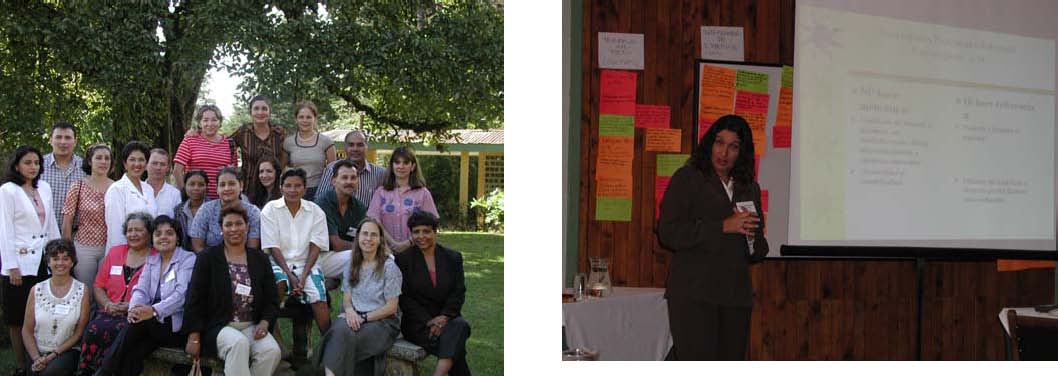
Costa Rica/Panamá Workshop Participants Diacuy Mesquita, Gender Facilitator
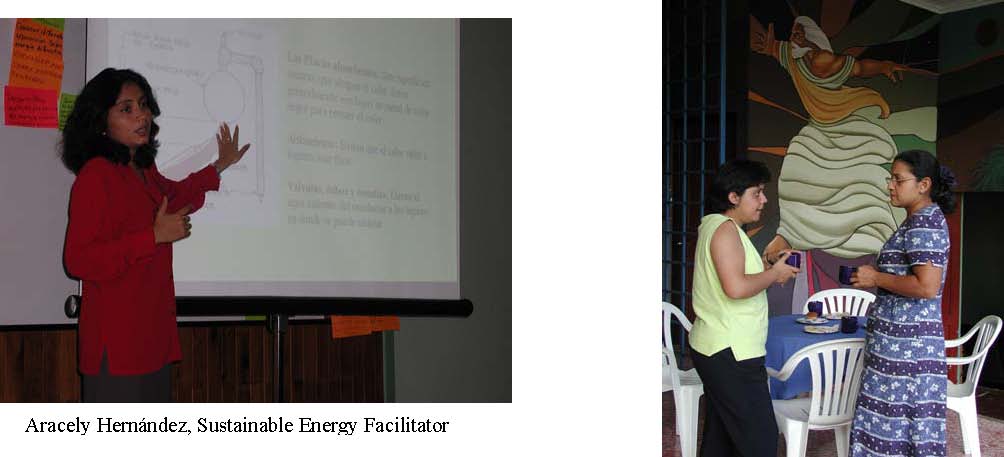
Vivian Lanuza, Regional Coordinator, and Yolanda Jimenez, Panamá Coordinator
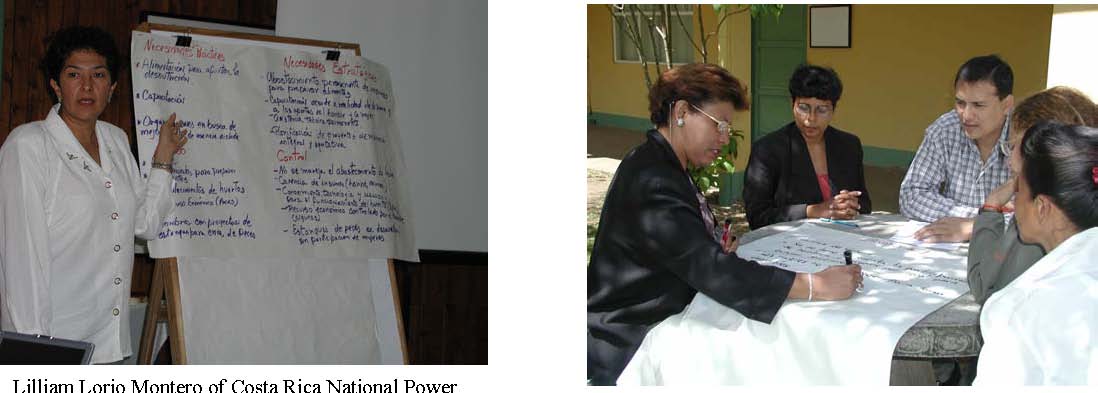
Workshop #2 – Honduras/Nicaragua
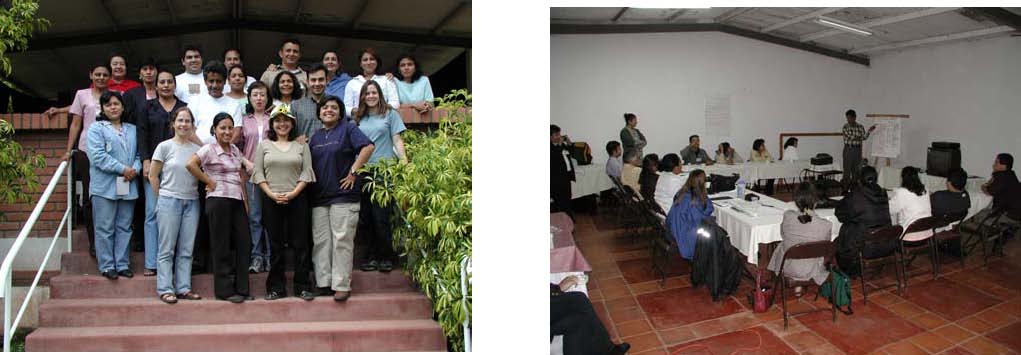
Carlos Velazquez of the Honduran Council on Science Honduras/Nicaragua Workshop Participants and Technology presents his working group’s findings
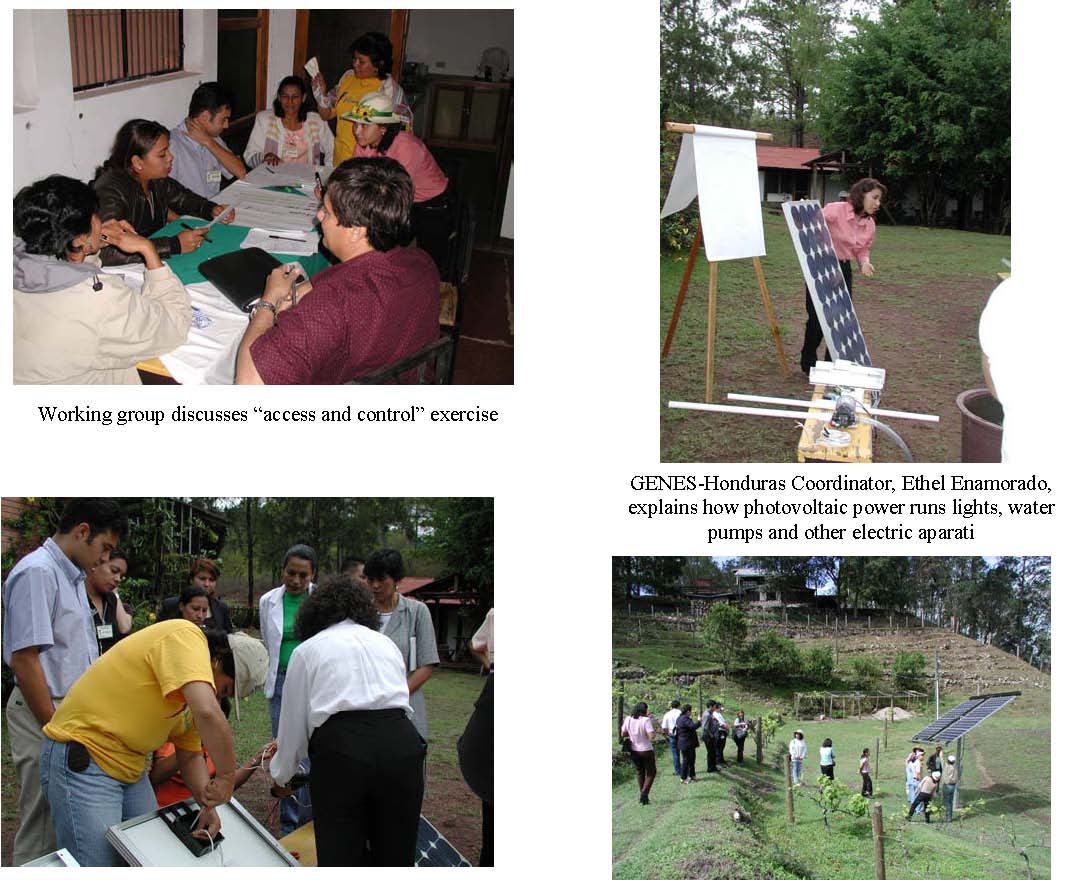
Workshop #3 – El Salvador, Guatemala & Mexico
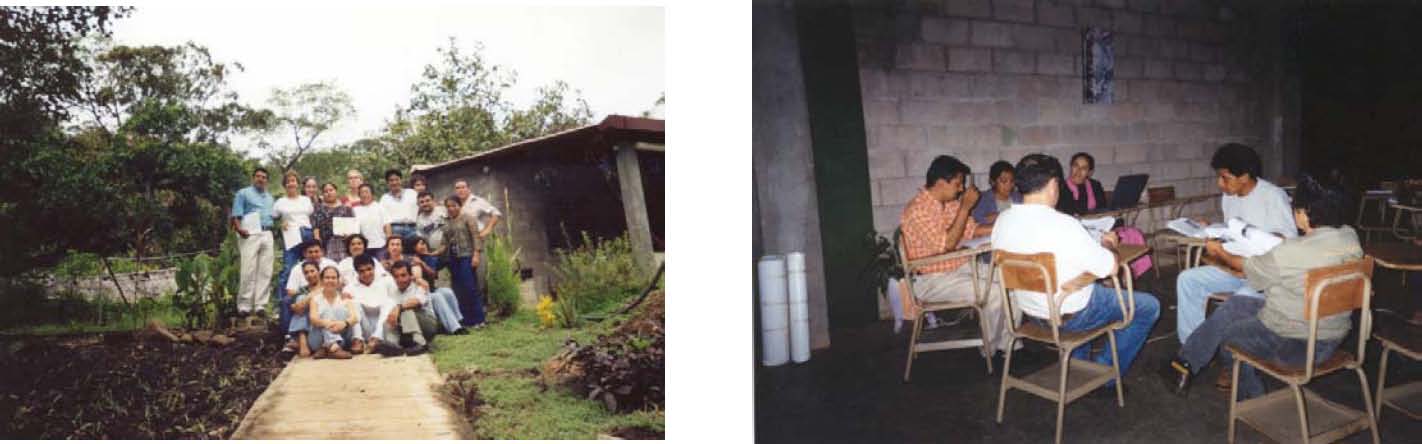
El Salvador/Guatemala/Mexico workshop participants Working group analyzing a case study
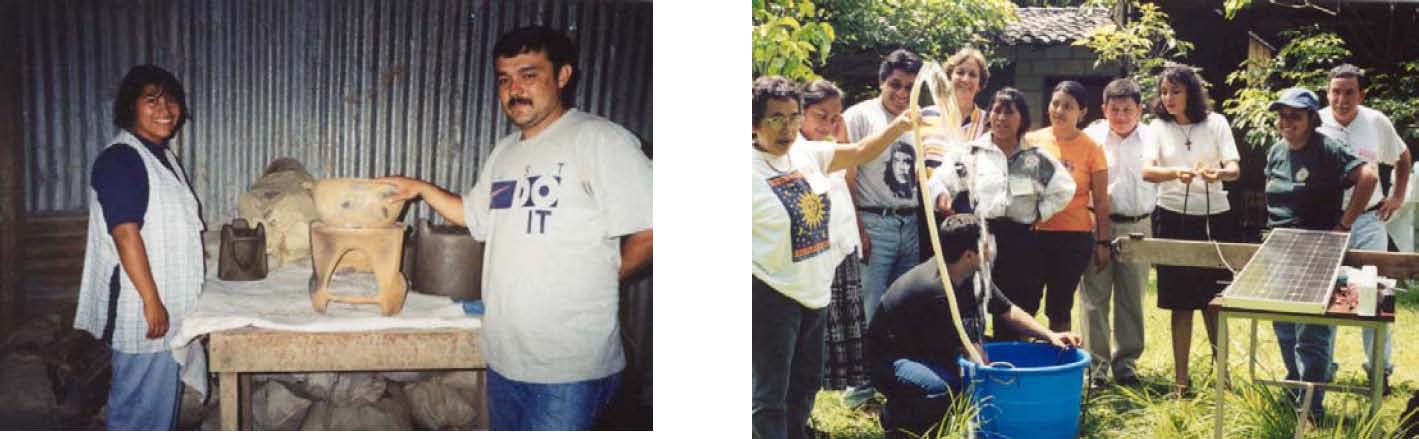
Natalia Satíz López of Mexico and Elmer Sosa of El Demonstrating simplicity of solar-powered water pumping Salvador with the locally produced ceramic stove
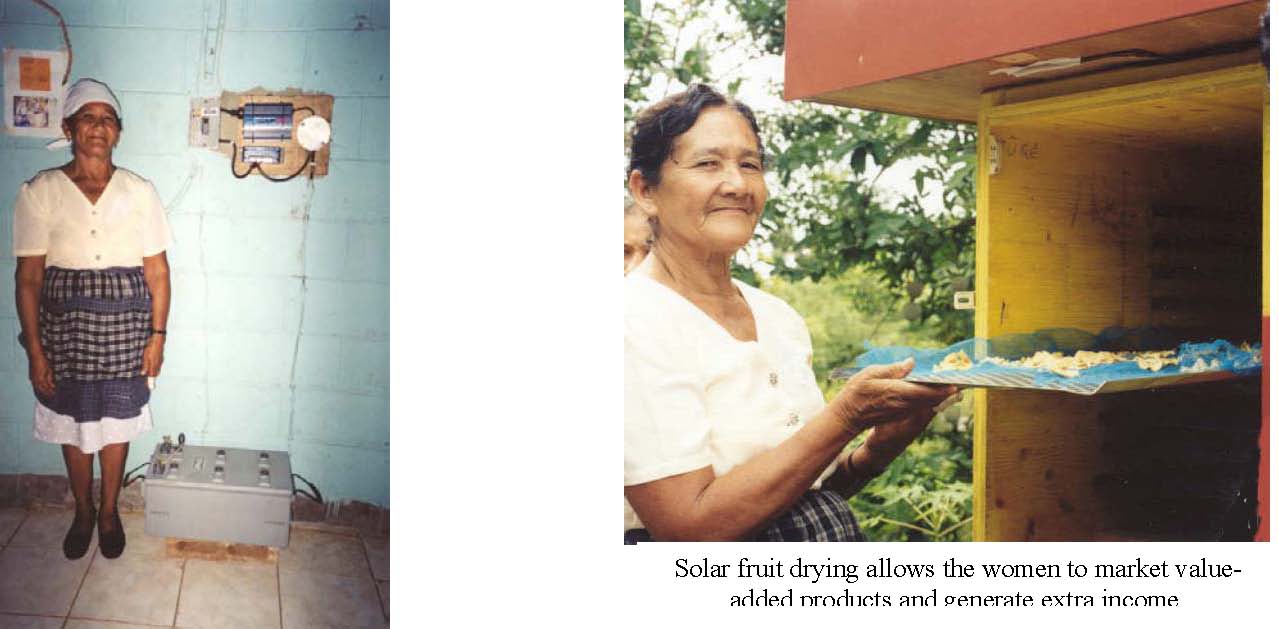
Local women use solar PV to operate the package sealer for fruit to be commercialized
GENES/ESMAP Regional Exchange #2 – Costa Rica